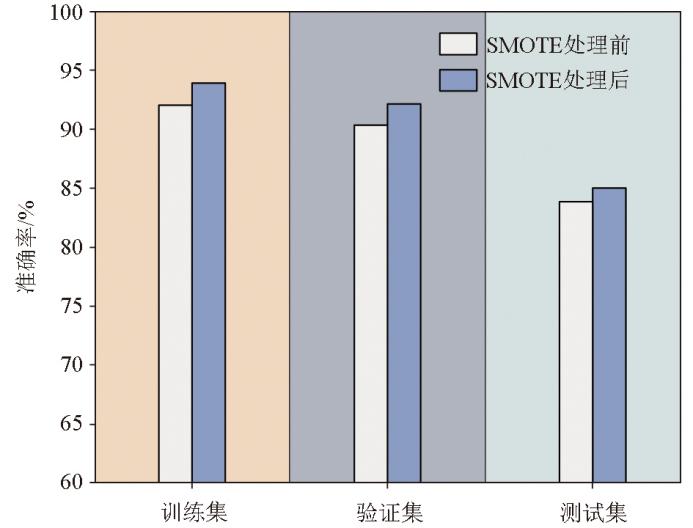
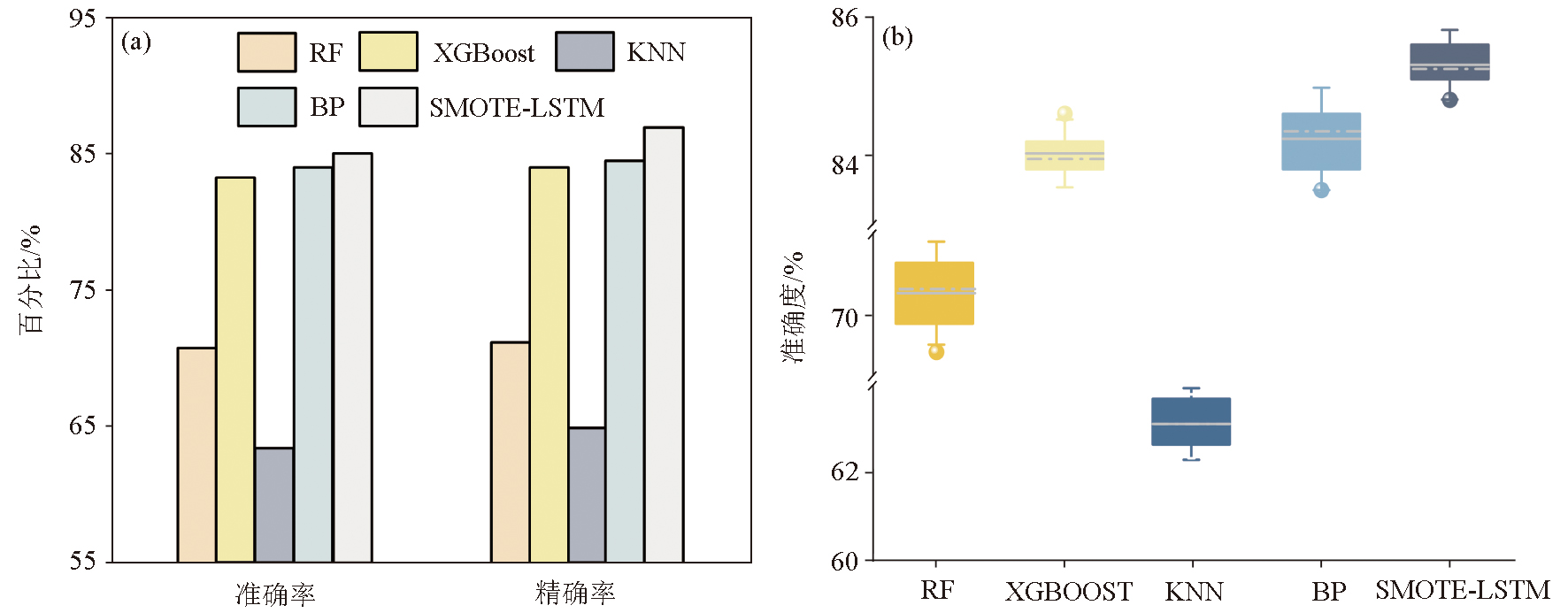
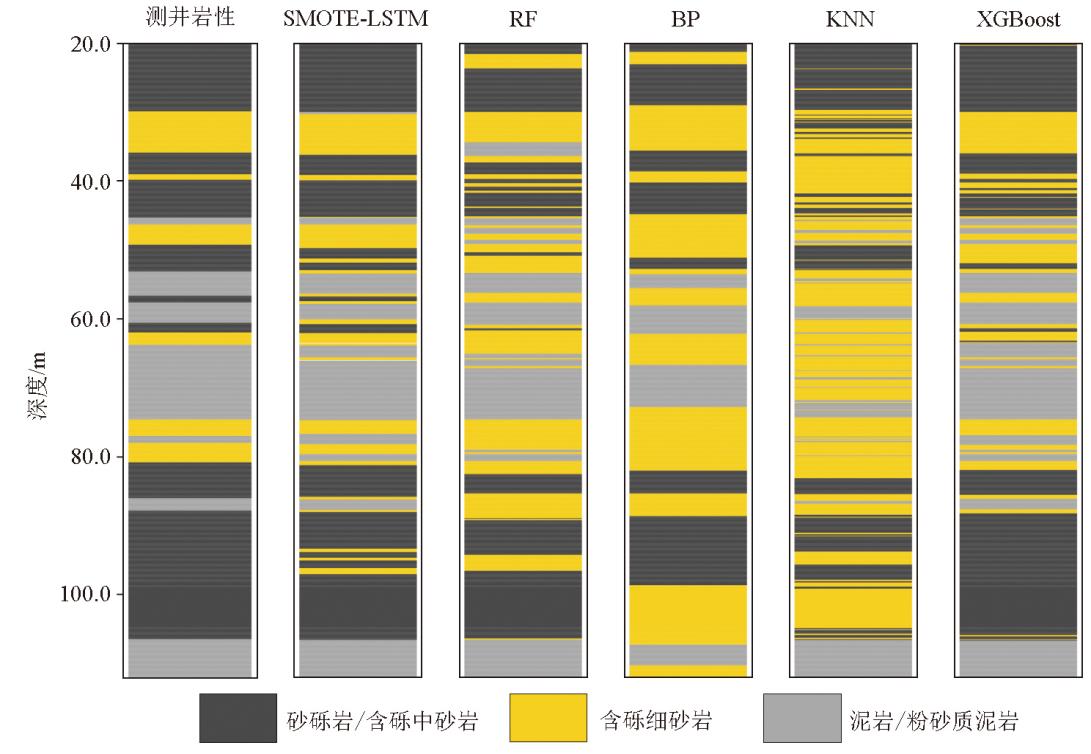
Artificial intelligence algorithms have been developed to automatically identify the spatial structures of formation lithologies from multivariate log data. They represent a promising approach to reducing lithology logging costs and mitigating the subjectivity inherent in lithology identification. Considering the imbalanced distribution of lithology sample data and the spatialtemporal variability in the relationships between log attributes and lithologies, this study constructed a synthetic minority oversampling technique (SMOTE)-long short-term memory (LSTM) hybrid model. The SMOTE algorithm effectively balances the sample distributions of different lithologies, while the LSTM algorithm, using its deep learning architecture, extracts lithological characteristics from the log sequence data. With the borehole log data and lithology records from a sandstone uranium deposit as training data, the SMOTE-LSTM hybrid model achieved a prediction accuracy exceeding 85% in lithology classification. Compared to several other machine learning methods, the SMOTE-LSTM hybrid model demonstrated significantly improved accuracy and reliability in lithology identification.
Xu Z H, Ma W, Li S C, et al. Lithology identification: Method,research status and intelligent development trend[J]. Geological Review, 2022, 68(6):2290-2304.
An P, Cao D P. Research and application of logging lithology identification based on deep learning[J]. Progress in Geophysics, 2018, 33(3):1029-1034.
[3]
Antariksa G, Muammar R, Lee J. Performance evaluation of machine learning-based classification with rock-physics analysis of geological lithofacies in Tarakan Basin,Indonesia[J]. Journal of Petroleum Science and Engineering, 2022, 208: 109250.
Fan Y R, Huang L J, Dai S H. Application of crossplot technique to the determination of lithology composition and fracture identification of igneous rock[J]. Well Logging Technology, 1999(1):53-56,64.
[5]
Moscatelli M, Piscitelli S, Piro S, et al. Integrated geological and geophysical investigations to characterize the anthropic layer of the Palatine hill and Roman Forum[J]. Bulletin of Earthquake Engineering, 2014, 12(3):1319-1338.
[6]
Sun J J, Li Y G. Multidomain petrophysically constrained inversion and geology differentiation using guided fuzzy c-means clustering[J]. Geophysics, 2015, 80(4):ID1-ID18.
Zhang Y G. The present and future of wave impedance inversion technique[J]. Geophysical Prospecting for Petroleum, 2002, 41(4):385-390.
[8]
Liu W, Du W F, Guo Y L, et al. Lithology prediction method of coal-bearing reservoir based on stochastic seismic inversion and Bayesian classification:A case study on Ordos Basin[J]. Journal Geophysics Engineering, 2022, 19(3):494-510.
Kuang L C, Liu H, Ren Y L, et al. Application and development trend of artificial intelligence in petroleum exploration and development[J]. Petroleum Exploration and Development, 2021, 48(1):1-11.
Wu X Y, Wang S H, Zhang Y D. Survey on theory and application of K-Nearest-neighbors algorithm[J]. Computer Engineering and Applications, 2017, 53(21):1-7.
[11]
Wang X D, Yang S C, Zhao Y F, et al. Lithology identification using an optimized KNN clustering method based on entropy-weighed cosine distance in Mesozoic strata of Gaoqing field,Jiyang depression[J]. Journal of Petroleum Science and Engineering, 2018, 166:157-174.
Lyu H Y, Feng Q. A review of random forests algorithm[J]. Journal of the Hebei Academy of Science, 2019, 36(3):37-41.
[13]
Xi Y T, Mohamed Taha A M, Hu A Q, et al. Accuracy comparison of various remote sensing data in lithological classification based on random forest algorithm[J]. Geocarto International, 2022, 37(26):14451-14479.
Ding S F, Qi B J, Tan H Y. An overview on theory and algorithm of support vector machines[J]. Journal of University of Electronic Science and Technology of China, 2011, 40(1):2-10.
Zhu Y X, Shi G R. identification of lithologic characteristics of volcanic rocks by support vector machine[J]. Acta PetroleiI Sinica, 2013, 34 (2):312-322.
Yan X Y, Gu H M, Xiao Y F, et al. XGBoost algorithm applied in the interpretation of tight-sand gas reservoir on well logging data[J]. Oil Geophysical Prospecting, 2019, 54(2):447-455,241.
Su G L, Deng F P. On the improving backpropagation algorithms of the neural networks based on MATLAB language:A review[J]. Bulletin of Science and Technology, 2003, 19(2):130-135.
[19]
Luo H, Lai F Q, Dong Z, et al. A lithology identification method for continental shale oil reservoir based on BP neural network[J]. Journal of Geophysics and Engineering, 2018, 15(3):895-908.
Liu W S, Kang S H, Jia L C, et al. Characteristics of paleo-valley sandstone-type uranium mineralization in the middle of erlian basin[J]. Uranium Geology, 2013, 29(6):328-335.
Fan R, Meng D Z, Xu D S. Survey of research process on statistical correlation analysis[J]. Mathematical Modeling and Its Applications, 2014, 3(1):1-12.
[22]
Fernandez A, Garcia S, Herrera F, et al. SMOTE for learning from imbalanced data:Progress and challenges,marking the 15-year anniversary[J]. Journal of Artificial Intelligence Research, 2018, 61:863-905.
[23]
Gers F A, Schmidhuber J, Cummins F. Learning to forget:Continual prediction with LSTM[J]. Neural Computation, 2000, 12(10):2451-2471.
[24]
Yu Y, Si X S, Hu C H, et al. A review of recurrent neural networks:LSTM cells and network architectures[J]. Neural Computation, 2019, 31(7):1235-1270.