Application of the surface-to-borehole direct current method for subgrade investigations in karst terrain
YU Xiao-Qing1(), WEN Jin-Hao2()
1. Jiangxi Ganyue Expressway Co. Ltd., Nanchang 330006, China 2. School of Geophysics and Space Exploration, East China University of Technology, Nanchang 330013, China
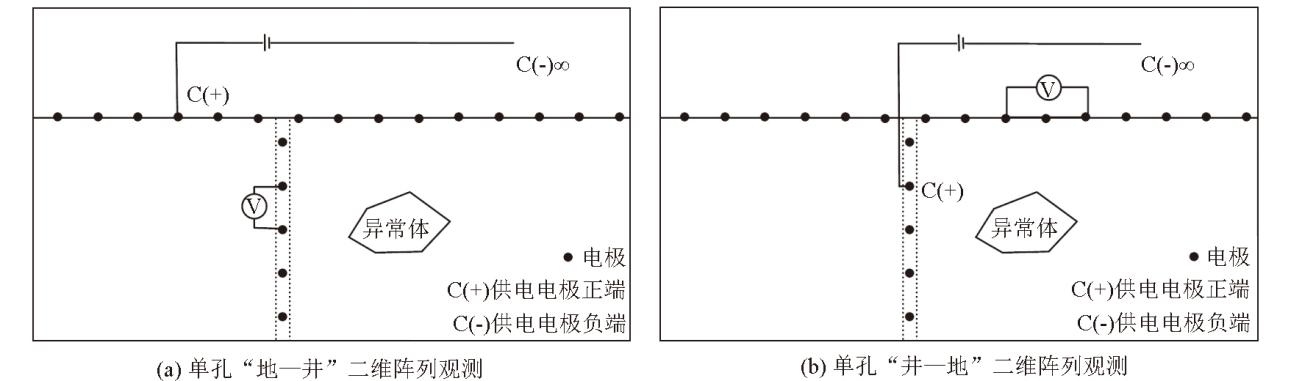
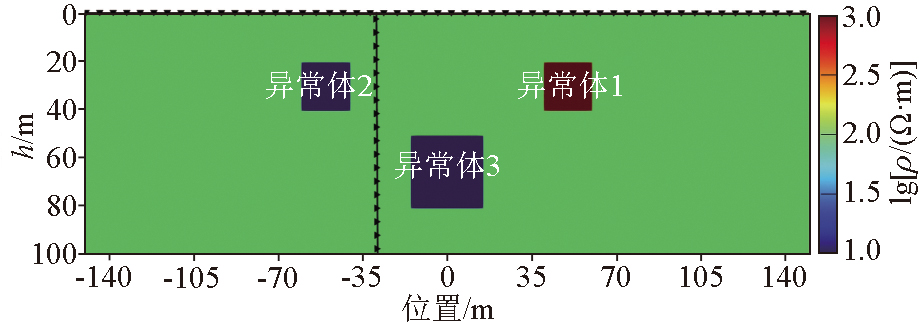
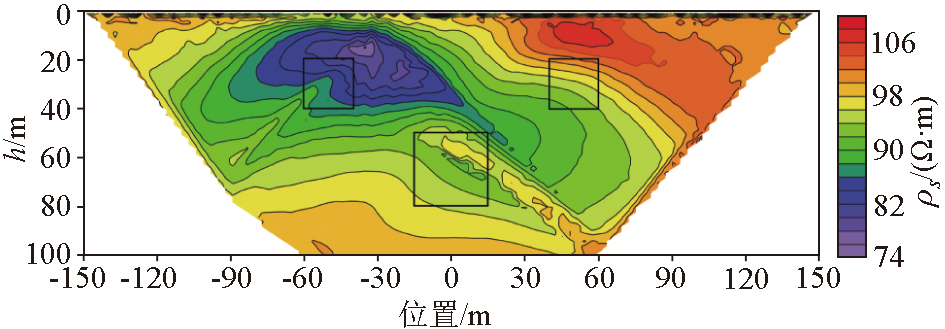
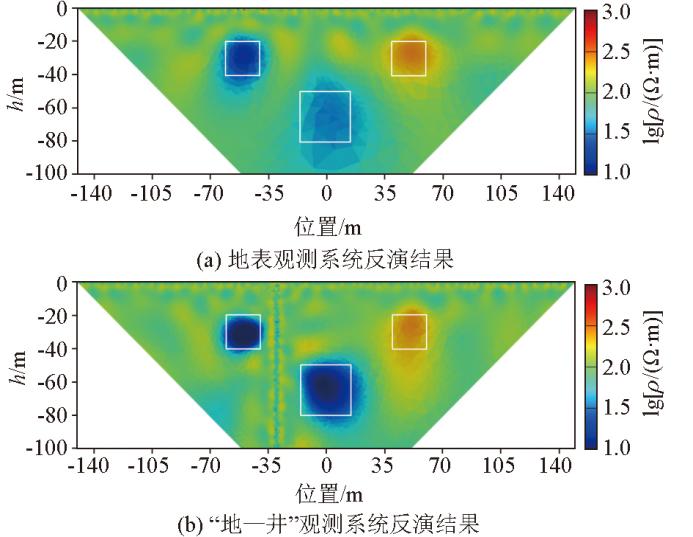
In karst subgrade exploration engineering, the application of the surface multi-electrode resistivity method faces challenges: on the one hand, the limitation of electrode array length constrains the effective exploration depth of this method; on the other hand, as the exploration depth increases, the available current distribution information from deeper layers decreases, resulting in a gradual weakening of the method's resolution capability, particularly in accurately predicting small-scale karst development areas at depth. To address this issue, the article proposes a solution: introducing wellbore electrodes on the basis of traditional surface multi-electrode resistivity observations to achieve “surface-to-wellbore” resistivity data acquisition. This strategy aims to increase and obtain deep current distribution information by adding wellbore electrodes, thereby enhancing the local effective exploration depth and improving the resolution of inversion results. To evaluate the effectiveness of the “surface-to-wellbore” resistivity observation method in obtaining deep karst information, the article first conducts an in-depth analysis using numerical simulation methods. Subsequently, the practical application value and effectiveness of this method are further demonstrated through inversion results based on measured data from karst subgrades. The research results show that the multi-electrode resistivity measurement technique with wellbore electrodes can significantly improve the resolution for identifying deep anomalies, providing an effective path to overcome the limitations of multi-electrode resistivity methods in deep karst exploration.
余小晴, 温金豪. 地—井直流电法在路基岩溶勘探中的应用[J]. 物探与化探, 2025, 49(6): 1459-1466.
YU Xiao-Qing, WEN Jin-Hao. Application of the surface-to-borehole direct current method for subgrade investigations in karst terrain. Geophysical and Geochemical Exploration, 2025, 49(6): 1459-1466.
Wu Y N. Application of the high-density electrical resistivity method to karst geological exploration in Quanhe,Laiwu City[J]. Carsologica Sinica, 2018, 37(4):617-623.
Dai J L, Lei M T, Jiang X Z, et al. Distribution and causes of Karst collapse in Yangtze River Economic Belt and its influence on engineering construction[J]. Geology in China, 2024, 51(1):184-202.
Xia B, Zhou P H, Li W T, et al. Study on application effect of different devices of high density resistivity method in Karst exploration[J]. Acta Geologica Sichuan, 2022, 42(3):514-519.
Xia S B, Liao G Z, Deng G S, et al. Application of high-density electrical resistivity tomography and audio magnetotellurics for groundwater exploration in the Karst area in southwestern China[J]. Geophysical and Geochemical Exploration, 2024, 48(3):651-659.
Zhou J B, Luo R H, He C K, et al. New geophysical evidence for Karst water-bearing seepage pathways in the Xiaohewei reservoir,Wenshan City[J]. Geophysical and Geochemical Exploration, 2023, 47(3):707-717.
Tang Y H, Wei D H, Suo L, et al. Application of seismic imaging method and ground penetrating radar method in Karst detection at the bottom of railroad tunnels[J]. Chinese Journal of Engineering Geophysics, 2021, 18(5):665-670.
Liu D K, Wei C F, Wu Y, et al. Analysis on the spectrum difference of electromagnetic method for the bottom of the pile in Karst detection project[J]. Chinese Journal of Underground Space and Engineering, 2020, 16(S2):971-975.
Wang W, Deng X H, Jin C, et al. The characteristics of Karst development in major projects revealed by electromagnetic wave computed tomography:A case for Karst investigation of a metro[J]. Science Technology and Engineering, 2020, 20(34):13977-13982.
Gao Y, Xiong H S, Peng M T, et al. High density electrical prospecting anomaly analysis of water-bearing structure in Karst area of southeast Chongqing[J]. Geophysical and Geochemical Exploration, 2016, 40(6):1108-1115.
Zheng Z L, Chen Y, Wang L J, et al. Application of high density electrical method in Karst tunnel detection of a highway[J]. Chinese Journal of Underground Space and Engineering, 2021, 17(S2):912-917,924.
Sun Z H. Study on the application effect of high-density electrical method in highway survey in complex Karst area[D]. Chengdu: Southwest Jiaotong University, 2014.
Xiao H Y, Lei X J, Lei W. The application of engineering exploring technology in lava exploration and its effects[J]. Journal of Catastrophology, 2007, 22(3):58-62.
Gao W F, Jia L B, Hu A S, et al. Research and application of DC multi array detection in Karst exploration[J]. Progress in Geophysics, 2021, 36(6):2687-2692.
Yu P Z, Zhang Z Y, Huang L P, et al. 2.5D inversion of borehole and surface multi-electrode DC data using unstructured mesh[J]. Progress in Geophysics, 2019, 34(4):1687-1693.
Zhang Z Y, Zhou F, Li Z L. 2.5D focusing inversion for boreholesurface electrical data based on minimum gradient support function[J]. The Chinese Journal of Nonferrous Metals, 2015, 25(11):3182-3189.
[18]
徐世浙. 地球物理中的有限单元法[M]. 北京: 科学出版社, 1994.
[18]
Xu S Z. The finite element method in geophysics[M]. Beijing: Science Press, 1994.
[19]
Zhdanov M S. Geophysical inverse theory and regularization problems[M]. Amsterdam: Elsevier Science, 2002.
[20]
Lelièvre P G, Farquharson C G. Gradient and smoothness regularization operators for geophysical inversion on unstructured meshes[J]. Geophysical Journal International, 2013, 195(1):330-341.
Yang L, Zhang Z Y, Li M, et al. 2D joint inversion of direct current resistivity and magnetotelluric sounding data[J]. Progress in Geophysics, 2016, 31(2):851-855.