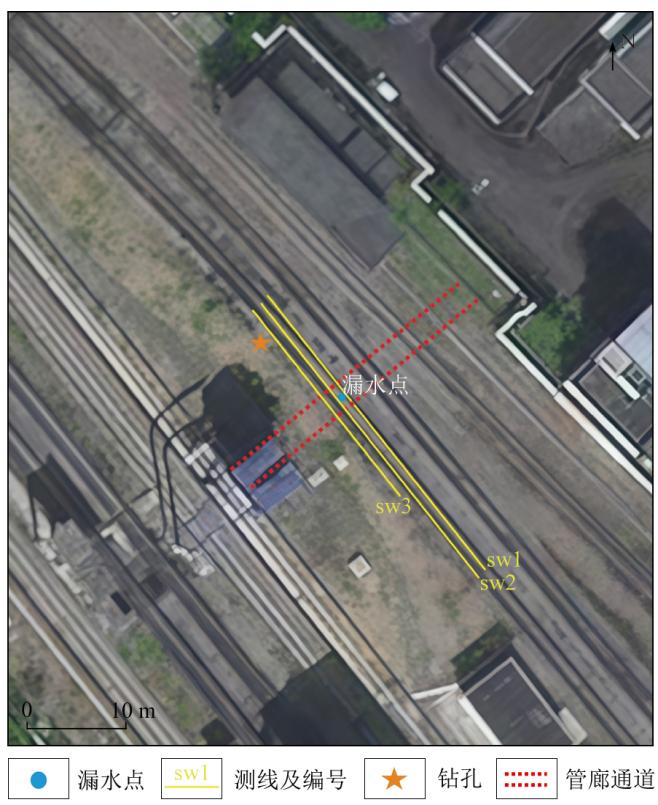
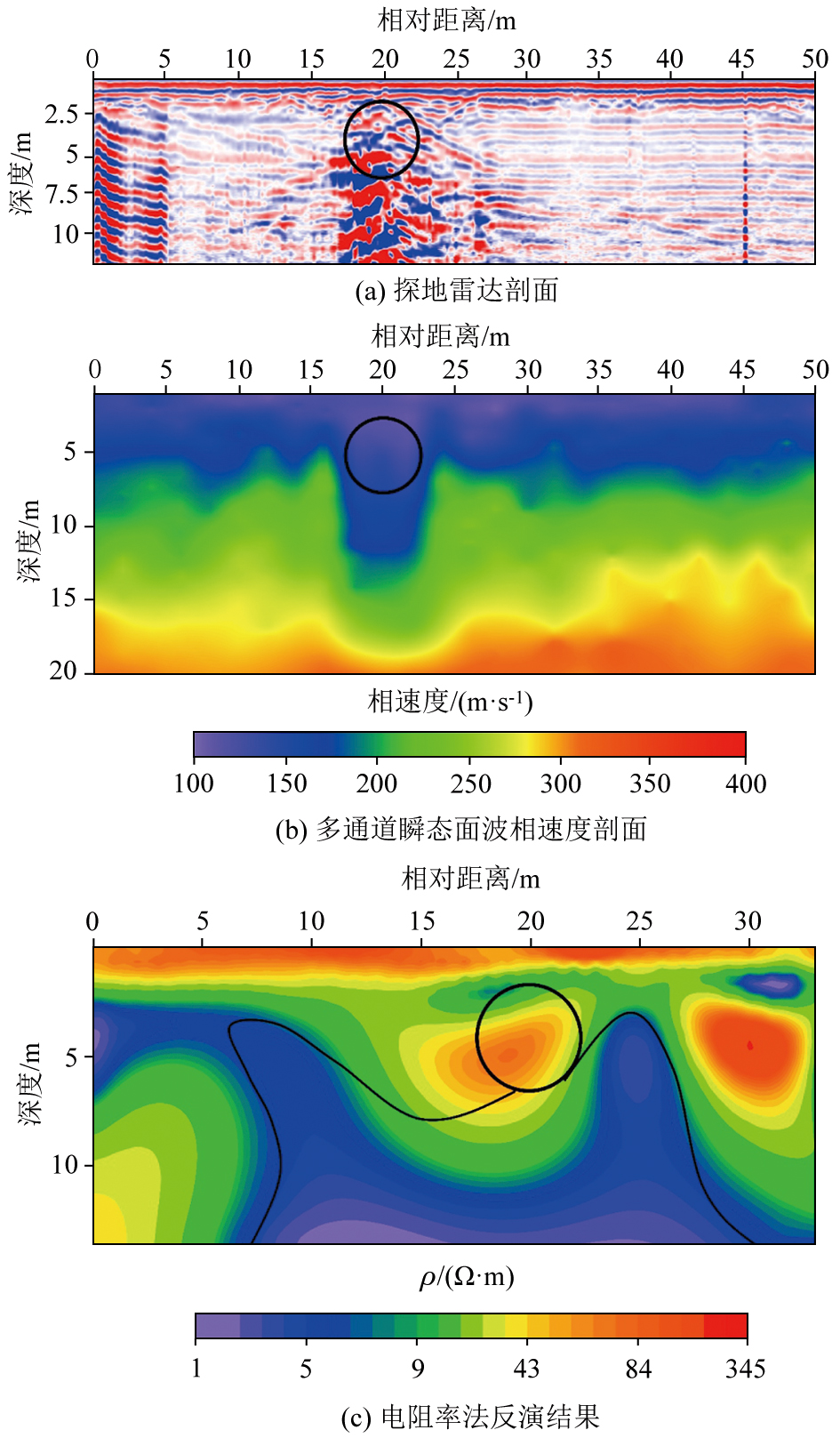
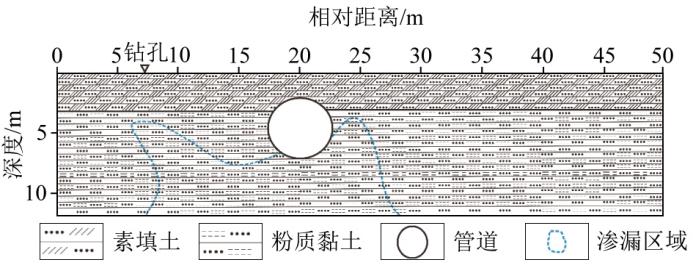
To reduce the economic losses caused by pipeline leakage, this paper applies a comprehensive geophysical exploration technology integrating ground-penetrating radar, multi-channel transient surface waves, and resistivity imaging to detect pipeline leakage at a power plant in Huainan, Anhui Province. The results show that the ground-penetrating radar oscillatory signals can reveal the leakage zone, the multi-channel transient surface wave can reflect the leakage severity within the detected area, and the electrical resistivity tomography can present the low-resistance morphology of the leakage zone. Demonstrated by the satisfactory outcomes, this integrated geophysical prospecting method proves to be an effective means to accurately locate the leakage positions for similar pipelines.
王彦兵, 金永军, 朱姝. 综合物探方法在某电厂管廊渗漏探测中的应用[J]. 物探与化探, 2025, 49(6): 1467-1472.
WANG Yan-Bing, JIN Yong-Jun, ZHU Shu. Application of an integrated geophysical prospecting method in pipeline leakage detection in a power plant. Geophysical and Geochemical Exploration, 2025, 49(6): 1467-1472.
Cao X Q, Ruan C M. Compilation of survey results on water loss rates in water supply networks of major cities worldwide[J]. Water Purification Technology, 2017, 36(4):6-14.
Bai R N. Development status of detection technology for water supply and drainage networks[J]. Enterprise Science and Technology Development, 2022, 484(2):43-45.
[4]
Datta S, Sarkar S. A review on different pipeline fault detection methods[J]. Journal of Loss Prevention in the Process Industries, 2016, 41(5):97-106.
doi: 10.1016/j.jlp.2016.03.010
Du G C. Application of zone metering method in water loss control of railway water supply network[J]. China Water & Wastewater, 2013, 29(15):138-140,145.
Zhang H L, Wu C B, Wang D, et al. Application of infrared thermal imaging in failure analysis of buried steam pipeline leakage[J]. China Special Equipment Safety, 2021, 37(6):68-71.
Liu H, Huang Z G, Yue Y P, et al. Characteristics analysis of ground penetrating radar signals for groundwater pipe leakage environment[J]. Journal of Electronics & Information Technology, 2022, 44(4):1257-1264.
Yu C Y, Lu X, Chen X F, et al. Morphology and influence range analysis of leakage areas in urban underground sewage pipelines[J]. China Water Transport, 2023, 23(24):66-68.
Hu Q F, Zheng Z H, Liu H, et al. Application of 3D ground penetrating radar to leakage detection of urban underground pipes[J]. Journal of Tongji University :Natural Science Edition, 2020, 48(7):972-981.
[11]
Caetano T R, Santos H A, van Dam R L. Leak identification in non-pressurized concrete pipelines by the use of geophysical methods[J]. Journal of Applied Geophysics, 2023, 208:104883.
doi: 10.1016/j.jappgeo.2022.104883
[12]
Dashwood B, Gunn D, Curioni G, et al. Surface wave surveys for imaging ground property changes due to a leaking water pipe[J]. Journal of Applied Geophysics, 2020, 174:12.
[13]
Cataldo A, Persico R, Leucci G, et al. Time domain reflectometry,ground penetrating radar and electrical resistivity tomography:A comparative analysis of alternative approaches for leak detection in underground pipes[J]. NDT & E Intemational, 2014, 62:14-28.
He Z L, He Y. Application research of integrated geophysical prospecting methods in urban geological survey:A case study of buried bedrock detection in dingcheng district,changde city,hunan province[J]. China Mining Magazine, 2024, 33(4):242-251.
Wang J C, Shi Y J, Zeng Y Q, et al. Application of integrated gravity,magnetic,and electrical geophysical prospecting methods in the exploration of dajin silver-copper polymetallic deposit[J]. China Mining Magazine, 2024, 33(S1):551-556.