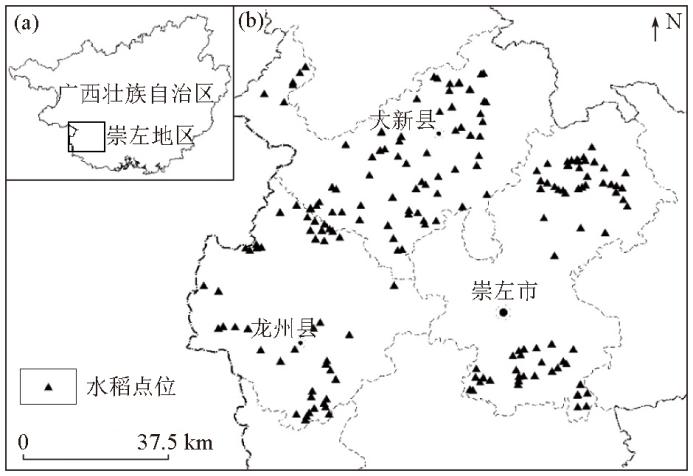
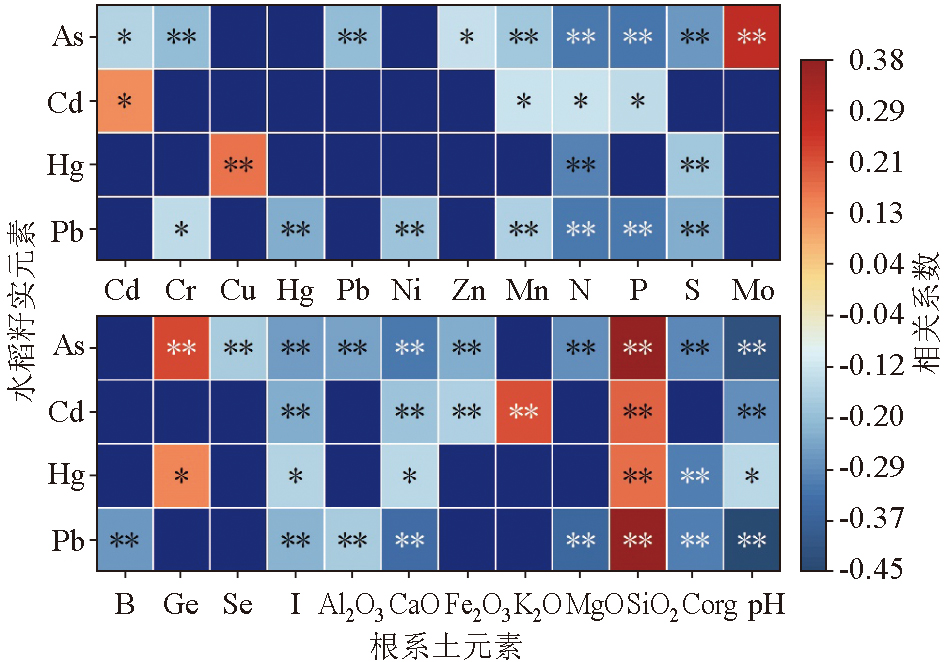
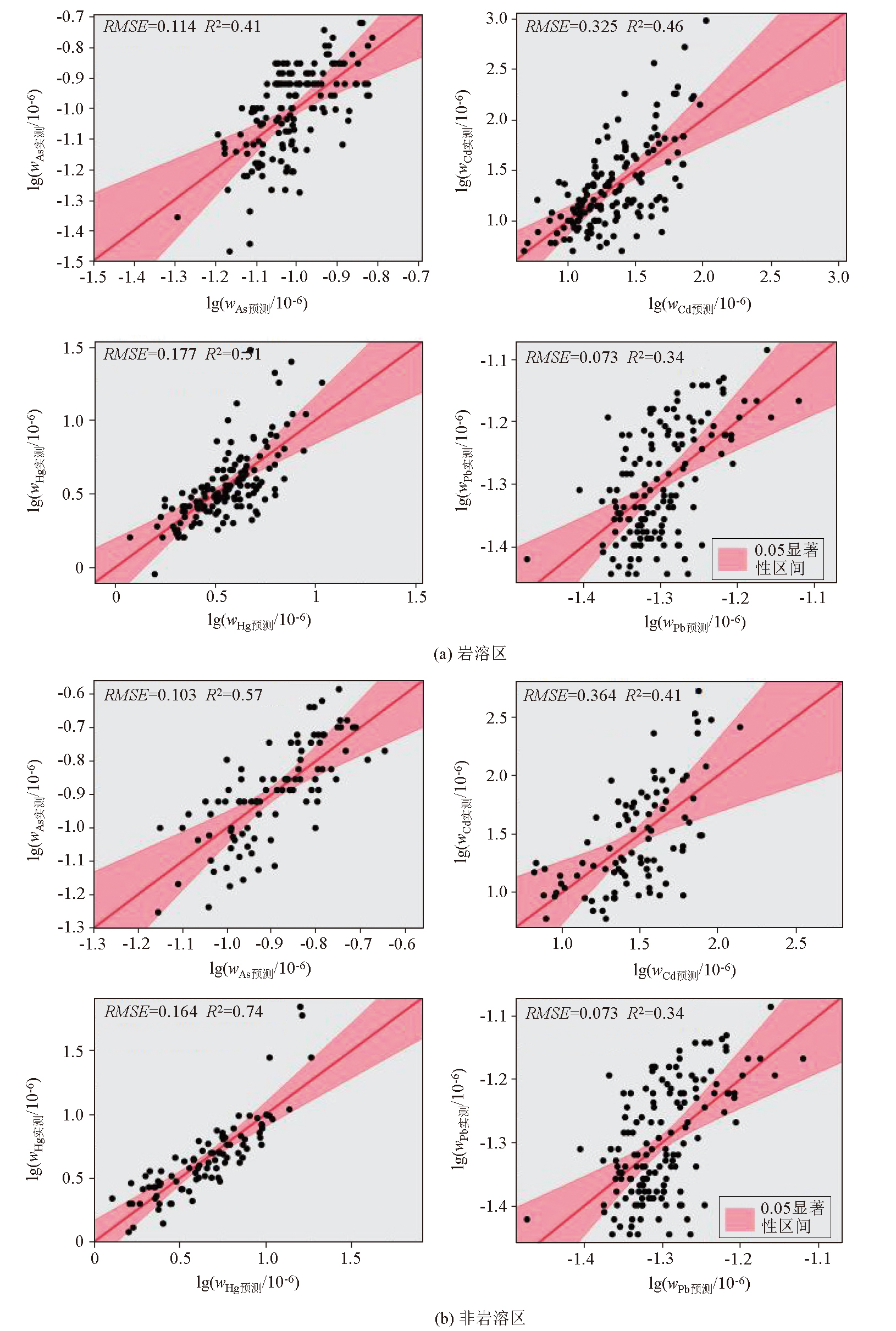
The Chongzuo area, located in southwestern Guangxi, encompasses Jiangzhou District, Daxin County, and Longzhou County, with the majority featuring karst topography. This study focused on 242 samples of rice grains and their corresponding rhizosphere soils from contiguous farmland in the region. These samples were analyzed to measure the contents of 26 elements in the soils, including arsenic (As), cadmium (Cd), and chromium (Cr), as well as the contents of As, Cd, mercury (Hg), and lead (Pb) in rice grains, using inductively coupled plasma mass spectrometry (ICP-MS), inductively coupled plasma optical emission spectrometry (ICP-OES), and atomic fluorescence spectrometry (AFS). By analyzing the characteristics of heavy metals in soils and rice grains, the influencing factors and fitting models of heavy metals from soils to rice grains were investigated. The results indicate that the content of oxides in soil was generally lower than the national average, while the content of heavy metals was relatively high, especially Cd and Hg. As and Cd in soils exhibited relatively high pollution risks. The contents of As, Cd, Hg, and Pb in rice grains from non-karst areas were generally higher than those from karst areas. The contents of As, Cd, Hg, and Pb in rice grains generally complied with food safety standards. As and Pb in rice grains showed significant correlations (dominated by negative correlations) with metal elements, non-metal elements, and oxides in rhizosphere soils, while Cd and Hg exhibited significant correlations with oxides in rhizosphere soils. Various fitting models of As in rice grains generally presented a coefficient of determination (R2) above 0.5, indicating better model performance than those for Cd, Hg, and Pb. After distinguishing between karst and non-karst areas, the R2 values of the fitting models were further improved. Among the factors influencing the contents of As, Cd, Hg, and Pb in rice grains, parent material played a more significant role than rice variety. This study preliminarily clarifies the key driving factors of heavy metal transfer in the soil-rice system in the karst area of Chongzuo, providing a theoretical and practical basis for the safe production of agricultural products, classification-based management of contaminated farmland, and policy formulation in similar karst areas of Southwest China.
陈上仁, 钟晓宇, 李杰, 杨敏云, 黄娟, 陈彪, 何耀烨. 崇左地区土壤—水稻籽实重金属元素迁移特征及拟合模型研究[J]. 物探与化探, 2025, 49(6): 1440-1448.
CHEN Shang-Ren, ZHONG Xiao-Yu, LI Jie, YANG Min-Yun, HUANG Juan, CHEN Biao, HE Yao-Ye. Heavy metal transfer in the soil-rice system of Chongzuo and corresponding fitting models. Geophysical and Geochemical Exploration, 2025, 49(6): 1440-1448.
Qian Z B, Sun L J, Xu S, et al. Distribution characteristics of heavy metals in soils of the Anhui section of the Huaihe River Basin[J]. Rock and Mineral Analysis, 2018, 37(2):193-200.
[2]
Luo X S, Yu S, Li X D. Distribution,availability,and sources of trace metals in different particle size fractions of urban soils in Hong Kong:Implications for assessing the risk to human health[J]. Environmental Pollution, 2011, 159(5):1317-1326.
doi: 10.1016/j.envpol.2011.01.013
[3]
Xiao Q, Zong Y T, Lu S G. Assessment of heavy metal pollution and human health risk in urban soils of steel industrial city (Anshan),Liaoning,Northeast China[J]. Ecotoxicology and Environmental Safety, 2015, 120:377-385.
doi: 10.1016/j.ecoenv.2015.06.019
pmid: 26114257
[4]
Katoh Y, Sato T, Yamamoto Y. Determination of multielement concentrations in normal human organs from the Japanese[J]. Biological Trace Element Research, 2002, 90(1):57-70.
doi: 10.1385/BTER:90:1-3
[5]
Feng D, Wang R X, Sun X A, et al. Heavy metal stress in plants:Ways to alleviate with exogenous substances[J]. Science of the Total Environment, 2023, 897:165397.
doi: 10.1016/j.scitotenv.2023.165397
Wang Y J, Wu T L, Zhou D M, et al. Research progress on evaluation of heavy metal pollution in farmland soil[J]. Journal of Agro-Environment Science, 2017, 36(12):2365-2378.
Zhang Y, Gu A H. Advances on damage and mechanisms of Cd,Pb,and Hg to blood vessels[J]. Journal of Environmental and Occupational Medicine, 2020, 37(7):727-733.
[8]
Isiozor N M, Kunutsor S K, Vogelsang D, et al. Serum copper and the risk of cardiovascular disease death in Finnish men[J]. Nutrition,Metabolism and Cardiovascular Diseases, 2023, 33(1):151-157.
doi: 10.1016/j.numecd.2022.09.024
Liu Q, Chen H Y, Tang D D, et al. Migration characteristics and quantitative model of heavy metals in the typical polluted areas of southern Jiangsu Province[J]. Environmental Science and Technology, 2016, 29(4):20-25.
Zhang X, Song J, Gao H, et al. Uncertainty of deducing Cd limit value in rape field soil by regression model method[J]. Research of Environmental Sciences, 2016, 29(8):1170-1179.
[11]
Wei R H, Chen C, Kou M, et al. Heavy metal concentrations in rice that meet safety standards can still pose a risk to human health[J]. Communications Earth & Environment, 2023, 4:84.
Wang J X, Hou Q Y, Ye D J, et al. Differences of cadmium mobility in paddy soils from different parent materials in the Pearl River Delta and its influencing factors[J]. Geoscience, 2023, 37(1):197-207.
Cai Q L, Lin D S, Wang G, et al. Differences in cadmium accumulation and transfer capacity among different types of rice cultivars[J]. Journal of Agro-Environment Science, 2016, 35(6):1028-1033.
Deng Q Y, Zhao Y J, Lin Q, et al. Regional distribuiton characterstics of cadmium and evaluation of soil pollution situation in Guangxi[J]. Environmental Engineering, 2019, 37(1):164-171,92.
Ren J, Zeng Y, Zhang B L, et al. Distribution characteristics and enrichment mechanisms of heavy metal pollution in high geochemical background areas[J]. Research of Environmental Sciences, 2024, 37(12):2745-2756.
[16]
鲍士旦. 土壤农化分析[M]. 3版. 北京: 中国农业出版社, 2000.
[16]
Bao S D. Soil and agricultural chemistry analysis[M]. 3rd ed. Beijing: China Agriculture Press, 2000.
[17]
侯青叶, 杨忠芳, 余涛, 等. 中国土壤地球化学参数[M]. 北京: 地质出版社, 2020.
[17]
Hou Q Y, Yang Z F, Yu T, et al. Soil geochemical dataset of China[M]. Beijing: Geological Publishing House, 2020.
Zhang Q, Liu X W, Shui Y, et al. Distribution of heavy metals in the upstream of Yellow River and ecological risk assessment[J]. Acta Scientiarum Naturalium Universitatis Pekinensis, 2021, 57(2):333-340.
Feng Z G, Liu X M, Wang S J, et al. Mineralogical and geochemical characteristics of the limestone weathering profile in Jishou,Western Hunan Province,China[J]. Geology-Geochemistry, 2002, 30(4):7-14.
[20]
Ghrefat H A, Yusuf N, Jamarh A, et al. Fractionation and risk assessment of heavy metals in soil samples collected along Zerqa River,Jordan[J]. Environmental Earth Sciences, 2012, 66(1):199-208.
doi: 10.1007/s12665-011-1222-6
[21]
Wang Q, Zeng X N, Song Q L, et al. Identification of key genes and modules in response to Cadmium stress in different rice varieties and stem nodes by weighted gene co-expression network analysis[J]. Scientific Reports, 2020, 10:9525.
doi: 10.1038/s41598-020-66132-4
pmid: 32533096
[22]
Xia W W, Ghouri F, Zhong M H, et al. Rice and heavy metals:A review of cadmium impact and potential remediation techniques[J]. Science of the Total Environment, 2024, 957:177403.
doi: 10.1016/j.scitotenv.2024.177403
Ma H H, Peng M, Liu F, et al. Bioavailability,migration and enrichment characteristics of heavy metals in farmland soil-crop system in typical carbonate rock areas of Guangxi[J]. Environmental Science, 2020, 41(1):449-459.
Cao N, Sun B B, Zeng D M, et al. Study on the relationship between the contents of heavy metals in rice and root soils in typical townships in the western Pearl River Delta[J]. Rock and Mineral Analysis, 2020, 39(5):739-752.
[25]
Zhao K L, Liu X M, Xu J M, et al. Heavy metal contaminations in a soil-rice system:Identification of spatial dependence in relation to soil properties of paddy fields[J]. Journal of Hazardous Materials, 2010, 181(1-3):778-787.
doi: 10.1016/j.jhazmat.2010.05.081
[26]
Ge Y N, Jia P H, Tian S K, et al. Cadmium distribution in rice:Understanding the role of plant nodes and growth stages[J]. Environmental Pollution, 2024, 362:124919.
doi: 10.1016/j.envpol.2024.124919
Yu F, Zhang F L, Jiang Y L, et al. Characteristics and comprehensive quality assessment of heavy metals in soil-crop system of high geological background area[J]. Environmental Science, 2025, 46(1):453-460.
Li B, Wang C Q, Dai T F, et al. Accumulation of heavy metals in rice seeds as influenced by metal speciation and soil properties[J]. Plant Nutrition and Fertilizer Science, 2007, 13(4):602-610.
[29]
Lavado R S, Rodríguez M, Alvarez R, et al. Transfer of potentially toxic elements from biosolid-treated soils to maize and wheat crops[J]. Agriculture,Ecosystems & Environment, 2007, 118(1-4):312-318.
doi: 10.1016/j.agee.2006.06.001
[30]
Karami M, Afyuni M, Khoshgoftarmanesh A H, et al. Grain zinc,iron,and copper concentrations of wheat grown in central Iran and their relationships with soil and climate variables[J]. Journal of Agricultural and Food Chemistry, 2009, 57(22):10876-10882.
doi: 10.1021/jf902074f
pmid: 19883069
[31]
Römkens P F A M, Guo H Y, Chu C L, et al. Prediction of Cadmium uptake by brown rice and derivation of soil-plant transfer models to improve soil protection guidelines[J]. Environmental Pollution, 2009, 157(8-9):2435-2444.
doi: 10.1016/j.envpol.2009.03.009
pmid: 19345457
Huang Y, Ouyang Y, Liu H, et al. Restriction of geological formation on soil properties and its ecological environmental effects:Example from red soil in the Xichang area[J]. Northwestern Geology, 2023, 56(4):196-212.
Li J, Zhu L X, Kang Z Q. Characteristics of transfer and their influencing factors of heavy metals in soil-crop system of peri-urban agricultural soils of Nanning,South China[J]. Carsologica Sinica, 2018, 37(1):43-52.
Zhou M, Mei L H, Liu B Q, et al. Geochemical characteristics and health risk assessment of heavy metal Cd in soil-rice system in Western Jiangxi Province[J]. Geology in China, 2025, 52(1):278-288.
Ma H H, Peng M, Guo F, et al. Influencing factors of Cd migration and enrichment in farmland soil-crop system in typical karst areas of Guangxi[J]. Environmental Science, 2021, 42(3):1514-1522.
Zhao K L, Fu W J, Dai W, et al. Characteristics and quantitative model of heavy metal transfer in soil-rice systems in typical rice production areas of Zhejiang Province[J]. Chinese Journal of Eco-Agriculture, 2016, 24(2):226-234.