



0 引言
前人已经对雄村矿集区的成矿地质背景、地质特征、矿床成因以及成矿预测等进行了详细的研究,积累了大量的基础地质资料与科研资料[7
1 研究区地质背景
拉萨地块位于我国青藏高原南部,南以雅鲁藏布缝合带(YZSZ)为界,北以班公湖—怒江缝合带(BNSZ)为界,是一条近EW向的巨型构造-岩浆带(图1)[14-15]。拉萨地块由北向南被狮泉河—纳木错蛇绿混杂岩带(SNMZ)、洛巴堆—米拉山断裂带(LMF)依次分割为北拉萨地块、中拉萨地块和南拉萨地块(图1b)[15-16]。冈底斯成矿带位于拉萨地体南部,是我国重要的矿产资源储备基地[1-
图1
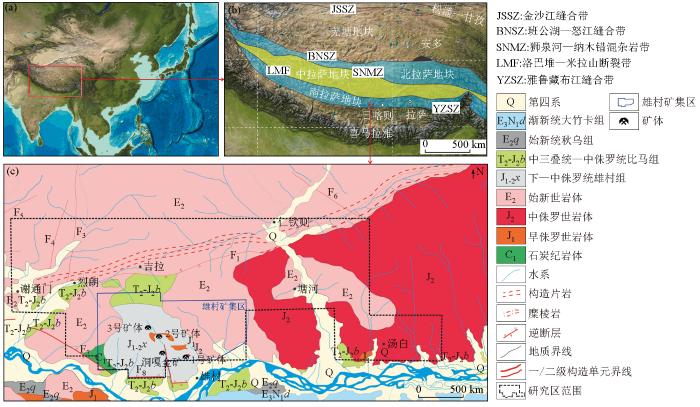
研究区位于冈底斯成矿带中段南缘,区内地层主要分布有中三叠统—中侏罗统比马组、中—下侏罗统雄村组、渐新统大竹卡组、始新统秋乌组以及第四系等(图1c)。其中,中三叠统—中侏罗统比马组岩性主要由玄武岩、安山岩、英安岩及少量砂岩、灰岩等组成,锆石U-Pb年龄显示其形成于184~175 Ma[24-25];下—中侏罗统雄村组地层为一套火山沉积岩,锆石U-Pb定年显示其形成于195~176 Ma,岩性以火山集块岩、火山角砾岩、凝灰岩为主,其次为砾岩、砂岩、粉砂岩、炭质页岩/板岩及少量不连续分布的灰岩[13,26-
区域上断裂构造发育,其中北部主要构造为EW向谢通门—努玛韧性剪切带,发育于始新世黑云二长花岗岩中,大部分已变质成糜棱岩及糜棱岩化岩石。受剪切带影响,剪切带两侧次级断裂发育,岩石破碎强烈,沿裂隙贯入后期岩脉。另外,研究区南部主体构造为断裂构造,呈近EW向、NW—SE向、近SN向和NE—SW向(图1c),其中NW—SE向断裂构造与成矿关系密切。研究区西南部还发育有轴线呈近EW向和NW—SE向的褶皱构造。
研究区内发现雄村超大型斑岩铜金矿集区,主要由1号、2号、3号矿体和洞嘎金矿等组成,1~3号矿体主要受控于NE—SE走向的侏罗纪斑岩体,而洞嘎金矿为2号矿体外围分布的次浅成低温热液型矿床[37]。1、2、3号矿体中石英—辉钼矿脉的辉钼矿Re-Os等时线年龄分别为(161.5±2.7) Ma、(172.6±2.1) Ma、(173±2.5) Ma[6],洞嘎Au矿的含Au绿泥石—硫化物脉中黄铁矿Re-Os等时线年龄为(180.4±2.8) Ma[37]。因此,雄村斑岩成矿系统主要发育两期成矿作用,早期为2号、3号矿体和洞嘎Au矿为代表的斑岩型Cu-Au矿化和斑岩体外围的Au矿化,形成时代为180~173 Ma;晚期为1号矿体为代表的斑岩型Cu-Au矿化和晚期叠加的次浅成低温热液型Zn-Ag-Au-Cu±Pb矿化,形成时代为162 Ma。此外,研究区内还发现汤白斑岩型铜矿、则莫多拉矽卡岩型铜矿等多个矿点,但勘查程度较低。
2 样品采集与数据分析
2.1 样品的采集与测试
1∶50 000水系沉积物地球化学测量数据来自研究团队于2005年至今在雄村矿集区及外围开展的矿产勘查工作[36,38
图2
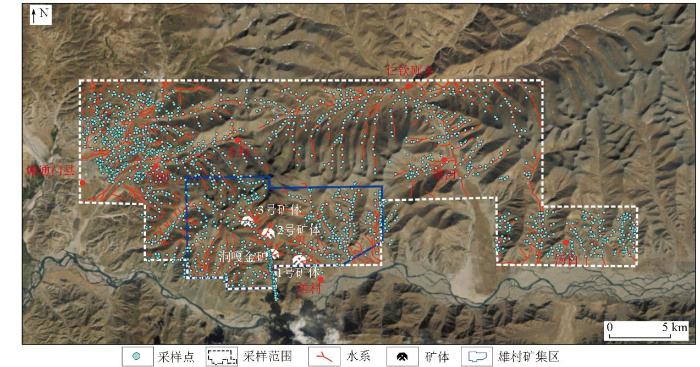
图2
雄村矿集区及其外围水系沉积物地球化学测量采样范围
Fig.2
Sampling range of geochemical measurement of stream sediments in Xiongcun ore concentration area and its periphery
样品原始质量大于500 g,保证样品过40~60目筛后质量≥300 g。加工后的样品及时编号并分为2份装袋,1份(150 g)送化验室分析,1份(150 g)装入副样库保存。样品测试元素为Au、Ag、Cu、Pb、Zn共5种,全部样品送至西南冶金分析测试所进行样品加工与分析测试。其中,Au采用发射光谱法(AES),Cu、Pb、Zn采用原子吸收光谱法(AAS),Ag采用火焰原子吸收光谱法(FAAS)测定,所有元素的分析检出限均符合规范要求。水系沉积物样品的分析以及质量控制均符合《地球化学普查规范1∶50 000》(DZ/T 0011—2015)、《岩石矿物分析试样制备》(DZ/T 0130.2—2006)相关要求。
2.2 地球化学参数特征
利用SPSS、Excel软件对水系沉积物样品分析结果进行统计,得到研究区样品中5种元素含量的最大值、最小值、平均值、中位数、标准离差、变异系数、浓度克拉克值等参数特征(表1)。
表1 研究区水系沉积物地球化学参数
Table 1
| Au | Ag | Cu | Pb | Zn | |
|---|---|---|---|---|---|
| 最大值 | 4430 | 4.786 | 1979 | 1690 | 1235 |
| 最小值 | 0.3 | 0.04 | 7.08 | 1.54 | 6.9 |
| 平均值 | 16.44 | 0.17 | 49.2 | 23.33 | 65.77 |
| 中位数 | 1.8 | 0.14 | 27.6 | 16.5 | 45.2 |
| 标准离差 | 132.98 | 0.21 | 105.67 | 47.29 | 83.87 |
| 变异系数 | 8.09 | 1.22 | 2.15 | 2.03 | 1.28 |
| 区域地壳丰度(西藏) | 1.6 | 0.085 | 23.8 | 28.1 | 77.4 |
| 富集系数 | 10.275 | 2 | 2.067 | 0.83 | 0.85 |
注:元素含量单位:Au为10-9,其余元素为10-6;变异系数=(标准离差/平均值)×100%;富集系数=(元素含量平均值/区域地壳丰度)×100%[
富集系数为特定地质体(矿床、岩体或矿物等)内某元素平均含量与该元素区域地壳丰度的比值,可以反映出元素相对富集或贫化的趋势[46]。富集系数通过量化元素富集程度建立分级标准:当比值超过1.5时为显著富集,1.2~1.5为较富集,0.8~1.2为正常分布,0.5~0.8为较贫化,低于0.5则属于显著贫化范畴[48]。变异系数CV是描述数据变异程度的指标,CV越大,表示该元素分布越不均匀,元素迁入以及带出作用越明显,找矿意义也就越大。其具体分级标准为:CV超过1.0(强变异型)指示元素空间分布极不均匀,0.7~1.0(变异型)反映出明显离散性,0.5~0.7(弱变异型)显示较弱的离散性,而CV低于0.5(均一型)则代表元素呈均匀分布状态[11,49]。
研究区内Au、Cu、Ag的富集系数均大于1.5,显示这些元素在局部区域具有较强的富集能力,其中尤以Au最为显著,Cu、Ag次之。此外,Au、Cu、Pb的变异系数大于2,Ag、Zn的变异系数则在1~1.5之间,均属于强变异型元素。这表明研究区水系沉积物样品中这些元素的含量分布极不均匀,不同地区变化较大。综上所述,本文认为研究区内Au、Cu离散程度大,分异性强,富集能力强。
3 水系沉积物地球化学特征
3.1 单元素异常特征
表2 研究区水系沉积物地球化学异常下限
Table 2
| 参数 | w(Au) /10-9 | w(Cu) /10-6 | w(Pb) /10-6 | w(Zn) /10-6 | w(Ag) /10-6 |
|---|---|---|---|---|---|
| 背景值 | 1.8 | 27.6 | 16.5 | 45 | 0.14 |
| 异常下限 | 6 | 69 | 45 | 123 | 0.3 |
图3
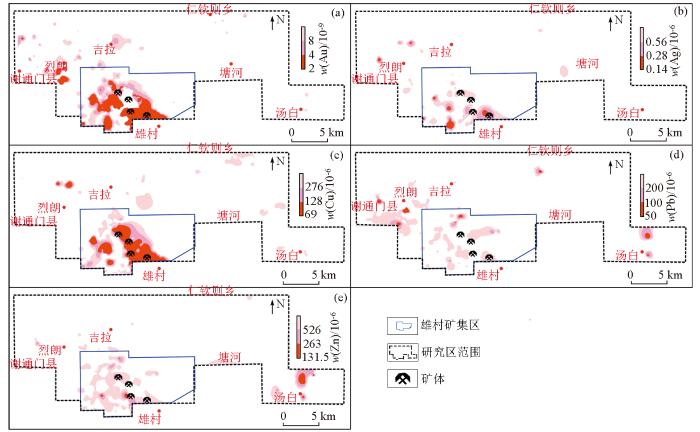
由元素异常分布可知:Cu异常主要集中分布于靠近雄村矿集区1号、2号矿体的位置,在雄村矿集区西北部也有零散分布的椭圆形异常(图3c),Cu异常强度较高、浓集中心明显,内、中带异常发育,局部发育外带,异常范围内出露下—中侏罗统雄村组凝灰岩地层和早侏罗世石英闪长斑岩;Au异常主要分布于雄村矿集区内,与已知矿体的套合程度较好,在研究区西北部也分布有小面积椭圆形异常(图3),Au异常分布面积广、强度较高,异常以内带为主,浓集中心明显,其中雄村矿集区内Au异常主要分布于下—中侏罗统雄村组凝灰岩地层、早侏罗世石英闪长斑岩和中侏罗世石英闪长斑岩中,研究区西北部异常则主要分布于中细粒黑云角闪石英闪长岩中,异常较为分散;Ag异常的分布特征与Au相似,但异常分布面积较小,主要分布在雄村矿集区,在研究区西部也有零散分布的椭圆形异常,与Au、Cu异常的套合关系好(图3b);Pb异常与Zn异常具有相似的分布特征(图3d、e),主要呈环状、半环状分布于Cu、Au、Ag异常周围,异常浓集中心明显,外、中带发育,局部发育内带,套合关系较好。
3.2 元素地球化学分布组合特征
3.2.1 相关分析
表3 研究区水系沉积物分析元素相关矩阵
Tab.3
| 元素 | Au | Ag | Cu | Pb | Zn |
|---|---|---|---|---|---|
| Au | 1 | ||||
| Ag | 0.452 | 1 | |||
| Cu | 0.614 | 0.480 | 1 | ||
| Pb | 0.479 | 0.327 | 0.365 | 1 | |
| Zn | 0.566 | 0.339 | 0.662 | 0.574 | 1 |
3.2.2 聚类分析
通过SPSS软件对研究区Au、Cu、Pb、Zn、Ag的水系沉积物测量原始数据进行标准化处理,再进行R型聚类分析,得到其聚类分析谱系(图4)。可以看出,当欧氏距离为16左右,水系沉积物样品中所测试的元素可以分为以下3类组合:Cu-Au-Zn、Pb、Ag。
图4
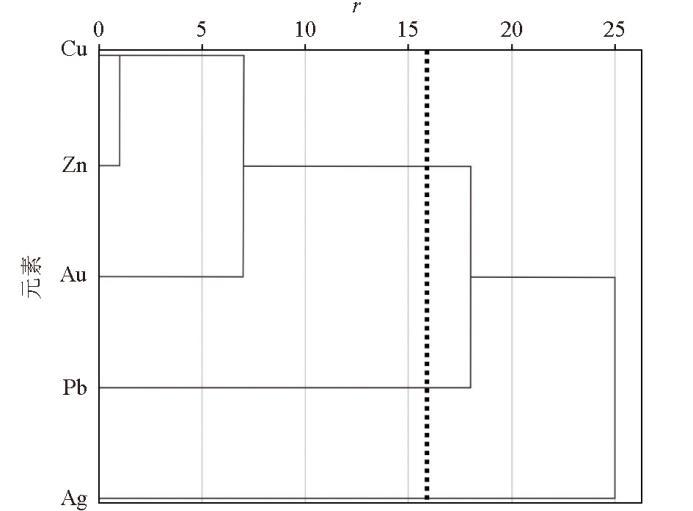
图4
研究区水系沉积物元素R型聚类分析谱系
Fig.4
Dendrogram of R-mode cluster analysis of elements in stream sediments in the study area
通过对单元素异常特征、地球化学参数特征、相关性分析及聚类分析的综合研究,可知研究区内Cu、Au异常强度大、浓集中心明显,两者分异性强,离散程度大,富集能力强;Cu、Au元素分群为一组,证明研究区内Cu、Au可能存在共生或者伴生关系。综上所述,认为研究区元素组合为Cu-Au元素组合及Ag-Pb-Zn元素组合,其中主成矿元素为Cu、Au,Ag、Pb和Zn可以作为Cu、Au的找矿指示元素。
4 综合异常圈定与评价
综合研究区各元素参数统计特征、单元素异常特征、多元统计分析结果以及研究区地形、地质特征差异,以异常元素套合情况好、元素组合与矿产或地质体关系密切、地理位置的重叠为原则进行综合异常的圈定,并对研究区内异常叠加情况不佳、成矿地质条件差的异常进行选择性的去除或者分割。基于以上原则,在单元素异常图基础上,划分出4个以Cu、Au异常为主的综合异常区(HS-1、HS-2、HS-3、HS-4)(图5)。在综合异常区圈定的基础上,对上述4个异常区开展了相应的异常区查证工作,为雄村矿集区外围及深边部的找矿突破提供了清晰的方向。
图5
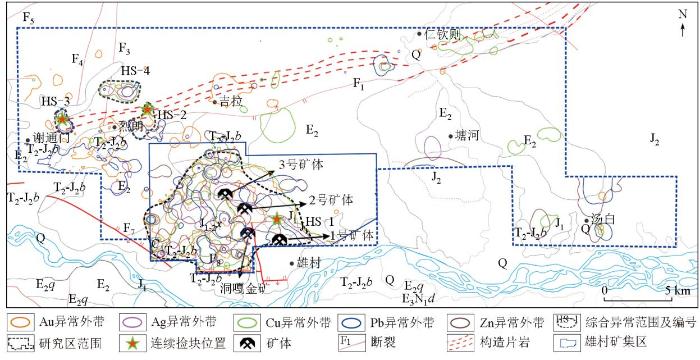
图5
雄村矿集区及其外围水系沉积物元素综合异常
Fig.5
Comprehensive anomaly of elements in stream sediments in Xiongcun ore concentration area and its periphery
4.1 HS-1综合异常区
HS-1异常区位于雄村矿集区,异常面积为60.74 km2,异常展布近EW向,形态似花瓣状。该异常内分布有Cu、Au、Ag、Pb、Zn异常,异常浓集中心明显,主成矿元素Cu、Au异常强度大、规模高,元素异常围绕已揭露矿化体分布。Ag、Pb、Zn异常呈环状围绕Cu、Au异常展布。异常区主要出露下—中侏罗统雄村组凝灰岩地层、早侏罗世石英闪长斑岩和中侏罗世石英闪长斑岩,分布有雄村1号、2号、3号矿体和洞嘎金矿。异常区成矿地质条件与已知矿体极为相似,有利的控矿地层条件(下—中侏罗统雄村组凝灰岩)以及含矿斑岩(中侏罗世石英闪长斑岩、早侏罗世石英闪长斑岩)在异常区内出露面积广泛,并且发育有钾硅酸盐化蚀变、黄铁绢英岩化以及青磐岩化等蚀变;异常区内NW—SE向次级断裂发育,可能为成矿提供了良好的热液通道。
图6
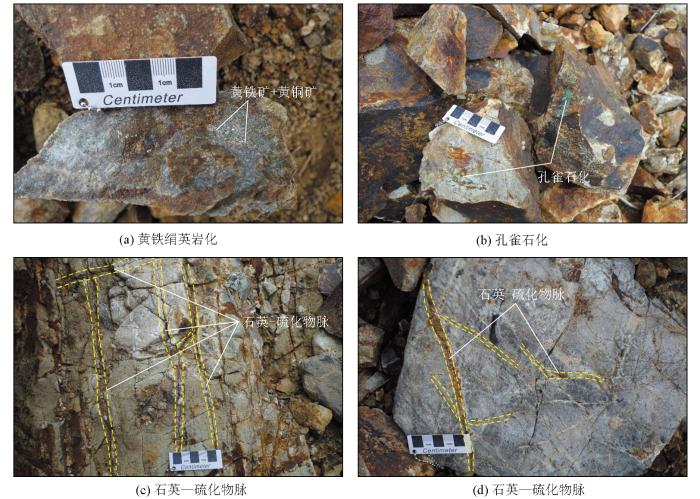
图6
HS-1异常区矿化露头及手标本照片
Fig.6
Photos of mineralized outcrops and hand specimens in the HS-1 anomaly area
综上所述,HS-1综合异常区地质、地球化学成矿条件良好,且目前已发现多个找矿线索,并发育多个大型铜金矿床;因此,该综合异常区有望进一步扩大找矿前景,寻找铜、金多金属矿产的潜力巨大,后续亟需开展进一步的工程验证工作。
4.2 HS-2异常区
HS-2异常位于日热地区东北部鲁康擦莫村附近,距雄村矿集区西北部约2.4 km,异常面积为3 km2。该异常区元素以Cu、Au为主,伴有Ag、Pb和Zn,且在异常区北侧套合相对较好,中部具有Au单元素异常高值点突出的特征。异常区出露地层为中三叠统—中侏罗统比马组火山岩,岩性主要为安山岩、英安岩。出露侵入岩主要为始新世黑云母花岗岩,受NE—SW向的韧性剪切带控制。异常查证过程中发现异常区边部的黑云母花岗岩中发育有石英—方铅矿脉,硫化物主要为方铅矿;异常区中心矿化类型以脉状矿化为主,蚀变以绿帘石化为主。该矿化带中发育大量硫化物脉,硫化物以黄铁矿和黄铜矿为主,部分硫化物氧化为褐铁矿和孔雀石(图7)。蚀变带顶部可见黑色千枚岩,内部无矿化现象。
图7
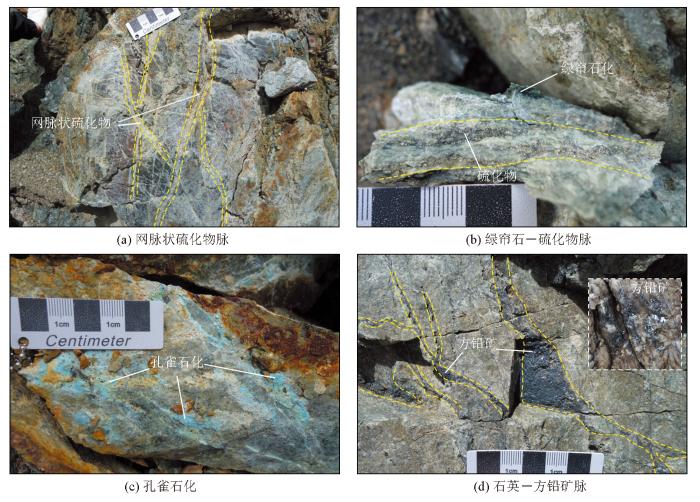
图7
HS-2异常区矿化露头及手标本照片
Fig.7
Mineralized outcrops and hand specimens in the HS-2 anomaly area
对该异常开展了连续捡块异常查证工作,捡块取样分析结果显示,该异常区捡块样品品位为:Cu,0.01%~0.07%;Mo,0.001%~0.003%;Ag,1.00~12.70 g/t;Au,0.01~0.08 g/t。结合水系沉积物地球化学测量显示的元素异常浓集中心明显、元素异常分带性强、具有银矿化显示等特征,该区具有寻找银多金属矿的找矿潜力,可开展进一步的勘查工作。
4.3 HS-3异常区
HS-3异常位于烈朗地区中部,谢通门县卡嘎镇附近,距离雄村矿集区北西约6 km,异常面积3.5 km2。异常元素为Au,伴生元素为Pb、Ag、Zn,异常强度较大,具有三级异常套叠、圈闭好、单元素异常高值点突出、组合异常套合极好等特点。异常区出露地层主要为第四系冲洪积层,由砂、砂砾石和亚砂土组成。侵入岩主要为始新世黑云钾长花岗岩、黑云二长花岗岩和黑云母角闪花岗岩,分别具有浅灰白色粗中粒斑状结构、灰白—灰色中粒斑状结构和灰绿色中粒结构,受到NE—SW向的韧性剪切带控制。黑云钾长花岗岩中发育绿泥石—绿帘石化和高岭土化蚀变,局部可见电气石脉、方解石脉和高岭石脉,有明显风化壳、火烧皮和硅化,风化壳下侧出露孔雀石化(图8),硅化中石英由于微量元素含量差异呈现出烟灰色、淡粉色和白色。
图8
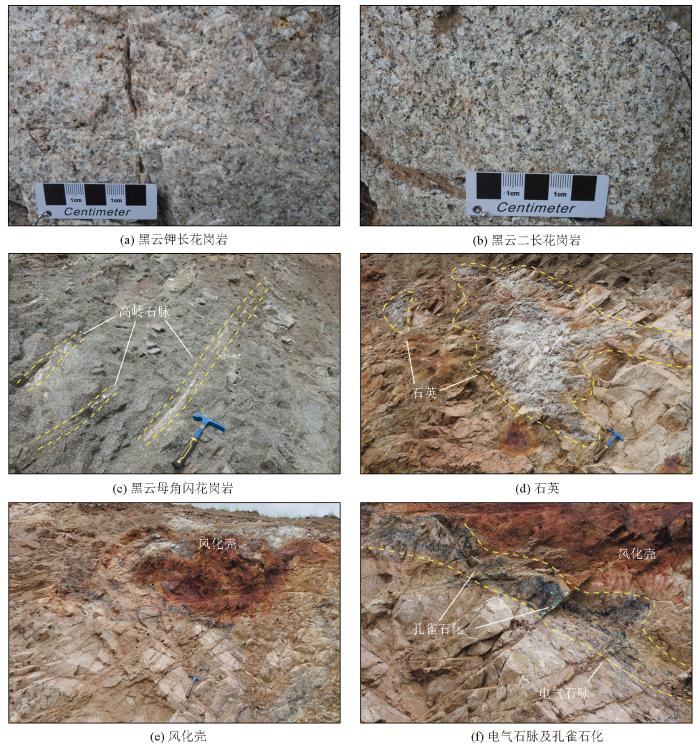
图8
HS-3异常区野外露头及手标本照片
Fig.8
Field outcrops and hand specimens in the HS-3 anomaly area
对该异常区开展了连续捡块异常查证,样品测试结果显示捡块样品品位为:Cu,0.002%~0.029%;Mo均低于检测限;Ag,1.04~1.8 g/t;Au,0.01~0.02 g/t。由此可见,大部分成矿元素低于检测限,仅局部Ag具有矿化显示。但由于该地区水系沉积物地球化学异常套合极好,推测该异常区深部可能存在隐伏矿体,具有寻找银多金属矿的找矿潜力,后续可开展进一步查证工作。
4.4 HS-4异常区
HS-4异常位于烈朗地区北部夏角村附近,距离雄村矿集区北西约4.8 km,异常面积4.5 km2。异常元素主要为Cu、Au,伴生元素为Pb、Ag、Zn。异常呈近椭圆状,强度较大,具有三级异常套叠、圈闭好、单元素异常高值点突出等特点。该地区地形切割较深,异常区边缘主要为始新世黑云角闪二长花岗岩,中心为始新世高硅花岗岩,岩体内基本未看见明显矿化和热液蚀变。高硅花岗岩中发育石英脉和电气石脉,部分石英和角闪石具有明显定向排列特征,主要受控于区域韧性剪切作用(图9)。
图9
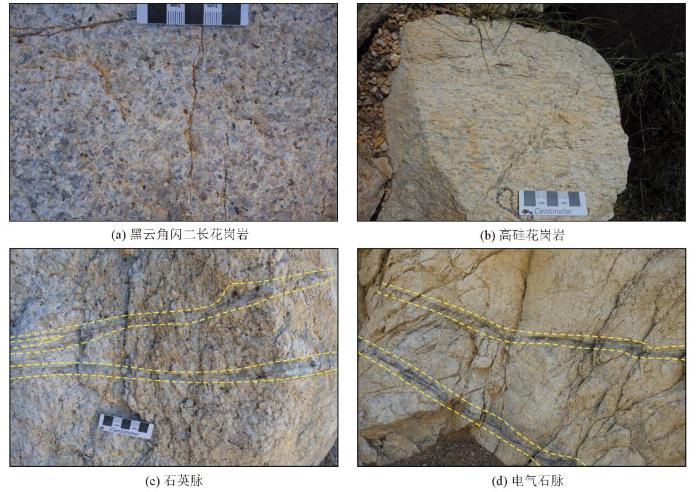
图9
HS-4异常区野外露头及手标本照片
Fig.9
Field outcrops and hand specimens in the HS-4 anomaly area
虽然该异常区异常浓集中心明显,但其上游靠近HS-2异常区,且异常区地势较低,因此推测可能为上游附近HS-2异常中的水系沉积物搬运至此,导致此处水系沉积物地球化学特征呈现异常。此外,在异常查证过程中,发现沟口存在少量含孔雀石转石,表明该区异常并非矿致异常,后续找矿潜力较小,其上游HS-2异常应为下一步找矿勘查的重点。
5 结论
1)通过对研究区1∶50 000水系沉积物地球化学样品测试数据进行多元统计分析,并结合各单元素异常特征分析,确定Cu、Au元素的地质和地球化学找矿条件优异,成矿潜力较强,是主要成矿元素,Ag、Pb、Zn为主成矿元素的伴生指示元素。
2)本区主攻矿种为铜、金,依据水系沉积物综合异常、成矿地质背景、矿产分布情况等,在全区共圈出4处综合异常区,其中HS-1、HS-2异常区综合异常强度最高、规模最大,浓集明显。
3)通过对圈定的综合异常进行评价以及地表异常查证,进一步提出了雄村矿集区及其外围找矿工作部署的地质、地球化学方面的证据,综合认为该区域找矿潜力较大,具有良好的找矿前景。
参考文献
The miocene gangdese porphyry copper belt generated during post-collisional extension in the Tibetan Orogen
[J].DOI:10.1016/j.oregeorev.2008.09.006 URL [本文引用: 3]
西藏斑岩—矽卡岩—浅成低温热液铜多金属矿成矿作用、勘查方向与资源潜力
[J].
Mineralization,exploration and resource potential of porphyry-skarn-epithermal copper polymetallic deposits in Tibet
[J].
西藏喜马拉雅成矿带错那洞超大型铍锡钨多金属矿床的发现及意义
[J].
First discovery and implications of Cuonadong superlarge Be-W-Sn polymetallic deposit in Himalayan metallogenic belt,southern Tibet
[J].
Lithospheric architecture of the Lhasa terrane and its control on ore deposits in the Himalayan-Tibetan Orogen
[J].
西藏谢通门县雄村斑岩型铜金矿床成因讨论:来自元素的空间分布特征的证据
[J].
A discussion on genesis of Xiongcun porphyry copper-gold deposit,Xietongmen,Xizang(Tibet):Evidence from elements spatial distribution characteristics
[J].
西藏雄村矿集区含矿斑岩成因及构造意义:来自年代学及地球化学的约束
[J].
Petrogenesis and tectonic implications of the ore-bearing porphyries in the Xiongcun district:Constraints from the geochronology and geochemistry
[J].DOI:10.18654/1000-0569/2019.07.10 URL [本文引用: 2]
西藏谢通门县雄村铜金矿床元素地球化学特征
[J].
Element geochemical characteristics of Xiongcun Cu-Au deposit in Xaitongmen County,Tibet
[J].
西藏谢通门县雄村斑岩型铜金矿区Ⅱ号矿体中辉钼矿Re-Os年代学及地质意义
[J].
2010b.Re-Os dating of molybdenite from orebody no.Ⅱ of the Xiongcun porphyry copper-gold metallogenic district,Xietongmen,Tibet and its geological significance
[J].
西藏谢通门县雄村铜金矿区及其外围的找矿前景地球化学评价
[J].
Geochemical evaluation of exploration prospect in the Xiongcun copper-gold district and peripheral areas,Xietongmen County,Tibet
[J].
西藏谢通门县雄村矿集区综合信息找矿模型及靶区预测
[J].
Comprehensive information prospecting model and target prediction for the Xiongcun Area,Xietongmen County,Tibet
[J].
西藏谢通门县雄村矿区外围土壤地球化学特征及异常评价
[J].
Soil geochemical characteristics and abnormal evaluation of Xiongxcun district peripheral areas,Xietongmen county,Tibet
[J].
Detrital zircon geochronology and geochemistry of Jurassic sandstones in the Xiongcun district,southern Lhasa subterrane,Tibet,China:Implications for provenance and tectonic setting
[J].
DOI:10.1017/S0016756818000122
URL
[本文引用: 1]

Jurassic sandstones in the Xiongcun porphyry copper–gold district, southern Lhasa subterrane, Tibet, China were analysed for petrography, major oxides and trace elements, as well as detrital zircon U–Pb and Hf isotopes, to infer their depositional age, provenance, intensity of source-rock palaeo-weathering and depositional tectonic setting. This new information provides important evidence to constrain the tectonic evolution of the southern Lhasa subterrane during the Late Triassic – Jurassic period. The sandstones are exposed in the lower and upper sections of the Xiongcun Formation. Their average modal abundance (Q21F11L68) classifies them as lithic arenite, which is also supported by geochemical studies. The high chemical index of alteration values (77.19–85.36, mean 79.96) and chemical index of weathering values (86.19–95.59, mean 89.98) of the sandstones imply moderate to intensive weathering of the source rock. Discrimination diagrams based on modal abundance, geochemistry and certain elemental ratios indicate that felsic and intermediate igneous rocks constitute the source rocks, probably with a magmatic arc provenance. The detrital zircon ages (161–243 Ma) and εHf(t) values (+10.5 to +16.2) further constrain the sandstone provenance as subduction-related Triassic–Jurassic felsic and intermediate igneous rocks from the southern Lhasa subterrane. A tectonic discrimination method based on geochemical data of the sandstones, as well as detrital zircon ages from sandstones, reveals that the sandstones were most likely deposited in an oceanic island-arc setting. These results support the hypothesis that the tectonic background of the southern Lhasa subterrane was an oceanic island-arc setting, rather than a continental island-arc setting, during the Late Triassic – Jurassic period.
Hydrothermal evolution and ore precipitation of the No.2 porphyry Cu-Au deposit in the Xiongcun district,Tibet:Evidence from cathodoluminescence,fluid inclusions,and isotopes
[J].DOI:10.1016/j.oregeorev.2019.103141 URL [本文引用: 2]
冈底斯造山带的时空结构及演化
[J].
Spatial-temporal framework of the Gangdese Orogenic Belt and its evolution
[J].
The Lhasa Terrane:Record of a microcontinent and its histories of drift and growth
[J].DOI:10.1016/j.epsl.2010.11.005 URL [本文引用: 2]
The origin and pre-Cenozoic evolution of the Tibetan Plateau
[J].DOI:10.1016/j.gr.2012.02.002 URL [本文引用: 1]
三江特提斯复合造山与成矿作用研究进展
[J].
Superimposed orogenesis and metallogenesis in Sanjiang Tethys
[J].
Metallogeny of the northeastern Gangdese Pb-Zn-Ag-Fe-Mo-W polymetallic belt in the Lhasa terrane,southern Tibet
[J].DOI:10.1016/j.oregeorev.2015.04.004 URL [本文引用: 1]
Multipulsed magmatism and duration of the hydrothermal system of the giant Jiama porphyry Cu system,Tibet,China
[J].Jiama is the largest porphyry-skarn ore system in the Gangdese metallogenic belt, Tibet. It is composed of porphyry Cu-Mo, Cu-polymetallic skarn, Cu-Pb-Zn manto, and distal vein Au orebodies with associated Ag, W, and Bi. However, the precise timing of the magmatism and hydrothermal events at Jiama remains obscure. Here, using high-precision chemical abrasion-isotope dilution-thermal ionization mass spectrometry (CA-ID-TIMS) U-Pb zircon dating of ore-bearing and post-ore intrusions, we accurately constrain the lifespan of magmatism and hydrothermal mineralization. Monzogranite porphyry dikes are cut by Cu-Mo vein mineralization in the deeper part of the system, indicating that they were emplaced pre-ore, and yield a crystallization age of 15.534 ± 0.007 Ma (mean square of weighted deviates [MSWD] = 0.99, n = 6). A granodiorite porphyry that cuts the monzogranite porphyry and hosts vein and disseminated chalcopyrite and molybdenite is considered synchronous with ore and yields a crystallization age of 15.368 ± 0.007 Ma (MSWD = 1.01, n = 5). These two phases of intrusions are cut by quartz-diorite porphyry bodies, which yield a crystallization age of 15.076 ± 0.006 Ma (MSWD = 0.13, n = 6) and contain weak, subeconomic Cu and almost no molybdenum mineralization. A post-ore barren quartz monzonite porphyry yields a crystallization age of 14.925 ± 0.006 Ma (MSWD = 1.12, n = 6). The lifespan of magmatism at Jiama is thus about 0.61 m.y. The difference with previous molybdenite Re-Os isochron ages from the porphyry (14.7 ± 0.3 Ma), hornfel (14.7 ± 0.4 Ma), and skarn (15.4 ± 0.2 Ma) suggests that high-precision chronology is required to decipher accurate timing of mineralization in porphyry systems such as Jiama. The 40Ar/39Ar ages of hydrothermal biotite coexisting with molybdenite in monzogranite porphyry and hornfels are 15.25 ± 0.17 Ma (MSWD = 1.6) and 15.25 ± 0.24 Ma (MSWD = 0.14), respectively, slightly younger than the granodiorite porphyry and older than weakly mineralized quartz diorite porphyry, which represents the time of the ore-forming hydrothermal event. Thus, Jiama is the product of pulsed magmatism during which a short-lived hydrothermal event formed the giant Cu polymetallic system.
Timing and mechanism of ore precipitation in porphyry Cu systems:Insight from LA-ICP-MS analysis of fluid inclusions and in situ oxygen isotope analysis of hydrothermal quartz at Zhunuo porphyry Cu deposit,China
[J].The timing and mechanism of ore precipitation in porphyry copper systems are hot topics and remain controversial. The large Miocene collision-related Zhunuo porphyry Cu deposit in the Gangdese belt of southern Tibet, China, was produced by multistage quartz veining and hydrothermal alteration, accompanied by Cu sulfide precipitation. In this study, we have combined cathodoluminescence (CL) petrography with in situ oxygen isotope analysis and fluid inclusion microthermometry and laser ablation-inductively coupled plasma-mass spectrometer microanalysis to constrain the growth history of individual quartz veins, the source and evolution of the hydrothermal fluids, and the timing and mechanism of ore precipitation at Zhunuo. Early quartz A veins associated with potassic alteration are composed of quartz, K-feldspar, biotite, Cu-Fe sulfides, and pyrite. Quartz B veins are composed of quartz, Cu-Fe sulfides, molybdenite, and pyrite. CL imaging shows that quartz grains in the A and B veins consist of abundant early generation of bright-luminescent quartz (QA and QB) with volumetrically minor later generation of dull-luminescent quartz (QA-crack and QB-crack) occurring in the voids or at the margins of the QA and QB veins with embayed contacts. Cu-Fe sulfides are generally in contact with the dull-luminescent quartz and locally in contact with the bright-luminescent quartz and K-feldspar in the A and B veins or occur as disseminations in the potassic-altered porphyries that have been overprinted by chlorite ± muscovite alteration.
The source and ore-forming processes of post-collisional Qulong porphyry Cu-Mo deposit in Tibet constrained by Mo isotopes
[J].DOI:10.1016/j.chemgeo.2024.122025 URL
Copper behavior in arc-back-arc systems:Insights into the porphyry Cu metallogeny of the gangdese belt,southern Tibet
[J].DOI:10.1007/s00126-023-01199-3
Petrogenesis and tectonic implications of the granite porphyry in the sinongduo Ag-Pb-Zn deposit,central Tibet:Constraints from geochronology,geochemistry,and Sr-Nd isotopes
[J].
DOI:10.3390/min14070710
URL
[本文引用: 1]
The Paleocene ore deposits related to the India–Asia continental collision are widely distributed in the Gangdese metallogenic belt. Among these, Sinongduo is the first discovered epithermal Ag-Pb-Zn deposit in the Lhasa terrane. However, there is still controversy over the ore-forming magma in this deposit. This study mainly reports new zircon U-Pb isotopic ages, whole-rock geochemistry, and Sr-Nd isotopic data for the granite porphyry from the Sinongduo deposit, aiming to discuss the petrogenesis and tectonic setting of the granite porphyry and its genetic link between the Ag-Pb-Zn mineralization. The results show that zircon U-Pb analyses yield ages of 62.9 ± 0.5 Ma and 59.0 ± 0.7 Ma for the granite porphyry, indicating that it formed during the Paleocene period. The timing of the granite porphyry intrusion is contemporaneous with the mineralization, suggesting that it is most likely the ore-forming magma in the Sinongduo deposit. The granite porphyry has high SiO2 and K2O, moderate Al2O3, and low Na2O, CaO, and FeOT contents, and it displays significant enrichments in LREEs and LILEs and depletions in HREEs and HFSEs, with negative Eu anomaly. The granite porphyry is a peraluminous series and can be classified as S-type granite. Moreover, the granite porphyry shows relatively high ratios of (87Sr/86Sr)i and low values of εNd(t). The geochemical and isotopic compositions of the granite porphyry from the Sinongduo area are similar to those of the upper continental crust, which suggests that the granite porphyry was most likely derived from the melting of the upper continental crust in the Lhasa terrane during the India–Asia collisional tectonic setting.
Geochronology and geochemistry of volcanic rocks of the Bima Formation,southern Lhasa subterrane,Tibet:Implications for early Neo-Tethyan subduction
[J].DOI:10.1016/j.gr.2019.11.005 URL [本文引用: 1]
Early Mesozoic arc-back-arc system in the leading edge of the Tibetan Plateau
[J].
S、Pb同位素对冈底斯斑岩铜矿带成矿物质来源和造山带物质循环的指示
[J].
Indications of S and Pb isotopes of the Gangdese Porphyry Copper Belt for the ore-forming source of material source and material recycling within the orogenic belt
[J].
西藏谢通门县雄村铜金矿主要地质体形成的时限:锆石U-Pb、辉钼矿Re-Os 年龄的证据
[J].
Time limit for formation of main geological bodies in Xiongcun copper-gold deposit,Xietongmen County,Tibet:Evidence from zircon U-Pb ages and Re-Os age of molybdenite
[J].
西藏谢通门雄村地区洞嘎金矿赋矿凝灰岩的年代学和地球化学特征
[J].
Geochronological and geochemical characteristics of the ore-bearing tuff of Dongga gold deposit in the Xiongcun area,Xizang (Tibet)
[J].
谢通门县幅(H45E016018)仁钦则幅(H45E016019)东嘎幅(H45E016020)艾玛幅(H45E016021)1∶5万区域地质调查报告
[R].
1∶50 000 regional geological survey report of the Xietongmen County sheet (H45E016018),Rinqênzê sheet (H45E016019),Donggar sheet (H45E016020) and Ngamring sheet (H45E016021)
[R].
U-Pb and Re-Os geochronological evidence for the Jurassic porphyry metallogenic event of the Xiongcun district in the Gangdese porphyry copper belt,southern Tibet,PRC
[J].DOI:10.1016/j.jseaes.2013.08.009 URL [本文引用: 1]
西藏雄村矿区Ⅲ号矿体硫、铅同位素特征及成矿物质来源
[J].
Geochemical characteristics of sulfur and lead isotope compositions and implications for the sourced of metals from No.Ⅲ ore body in Xiongcun Mining Area,Tibet
[J].
西藏拉萨地体南缘汤白地区始新世辉绿岩脉——新特提斯洋壳断离的证据
[J].
Eocene diabase dikes in the Tangbai area,southern margin of Lhasa terrane,Tibet:Evidence for the slab break-off of the Neo-Tethys Ocean
[J].
Early-Middle Jurassic (182-170 Ma) Ruocuo adakitic porphyries,southern margin of the Lhasa terrane,Tibet:Implications for geodynamic setting and porphyry Cu-Au mineralization
[J].DOI:10.1016/j.jseaes.2019.01.042 URL
Early Carboniferous back-arc rifting-related magmatism in southern Tibet:Implications for the history of the Lhasa terrane separation from Gondwana
[J].
Origin of Early Eocene diabase dikes in the southern Lhasa terrane:Implications for the Neo-Tethyan slab breakoff
[J].
西藏自治区谢通门县雄村矿区铜矿勘探报告
[R].
Exploration report of the copper deposit in the Xiongcun Mining Area,Xietongmen County,Tibet Autonomous Region
[R].
Origin of the Dongga Au deposit in the giant Xiongcun porphyry Cu-Au district,Tibet,China:Constraints from multiple isotopes (Re,Os,He,Ar,H,O,S,Pb) and fluid inclusions
[J].DOI:10.1016/j.oregeorev.2024.106173 URL [本文引用: 3]
西藏日喀则谢通门县塘河多金属矿地质预查报告
[R].
Geological preliminary survey report of the Tanghe polymetallic deposit,Xietongmen County,Shigatse,Tibet
[R].
西藏日喀则谢通门县吉拉多金属矿地质预查报告
[R].
Geological preliminary survey report of the Jila polymetallic deposit,Xietongmen County,Shigatse,Tibet
[R].
西藏日喀则谢通门县烈朗多金属矿地质预查报告
[R].
Geological preliminary survey report of the Lielang polymetallic deposit,Xietongmen County,Shigatse,Tibet
[R].
西藏日喀则市汤白铜矿地质勘查报告
[R].
Geological exploration report of the Tangbai copper deposit,Shigatse,Tibet
[R].
西藏日喀则谢通门县日热铜矿预查地质报告
[R].
Geological preliminary survey report of the Rire copper deposit,Xietongmen County,Shigatse,Tibet
[R].
西藏日喀则谢通门县则莫多拉铜矿地质勘查报告
[R].
Geological exploration report of the Zemoduola copper deposit,Xietongmen County,Shigatse,Tibet
[R].
西藏日喀则谢通门县洞嘎普铜矿地质勘查报告
[R].
Geological exploration report of the Donggapu copper deposit,Xietongmen County,Shigatse,Tibet
[R].
内蒙古阿拉格乌拉地区土壤地球化学特征及找矿预测
[J].
Soil geochemical characteristics and prospecting prediction in Alagewula Area,Inner Mongolia
[J].
藏东达翁金矿区土壤地球化学特征与找矿潜力研究
[J].
Soil geochemical characteristics and prospecting potential of the Daweng gold mine in eastern Xizang
[J].
勘查数据分析(EDA)技术的应用
[J].
Application of the exploratory data analysis technique
[J].
Geochemical anomaly and mineral prospectivity mapping in gis
[J].
Background and threshold:Critical comparison of methods of determination
[J].DOI:10.1016/j.scitotenv.2004.11.023 URL [本文引用: 1]
岩石地球化学异常下限的确定方法对比:以云南思姑锡矿区为例
[J].
Comparison of low limit determination methods of petro-geochemical anomly:Taking Sigu area of Yunnan sa an example
[J].


