



0 引言
土壤中重金属含量在自然和人为双重因素影响下,往往具有一定的时空变异特征,随着城镇化、工业化和农业集约化快速推进,大规模的人类活动改变了土壤中重金属的分布特征,使得一些重金属在土壤中富集,造成了严重的污染。特别是在城市工业区,人类活动更加频繁,金属冶炼、机械加工、化工生产、化石燃料使用、交通运输、人类生活等活动使得工业区土壤重金属污染状况更加严峻[1
山东作为我国经济发达省份,是华东地区重要的经济和工业中心,高强度的工业活动造成的土壤质量下降,尤其是土壤重金属污染已成为当地日益紧迫的环境问题,亟须引起人们的高度重视。目前针对山东省土壤重金属污染的研究主要集中在农业用地[25
1 研究区概况
2 研究方法
2.1 样品采集
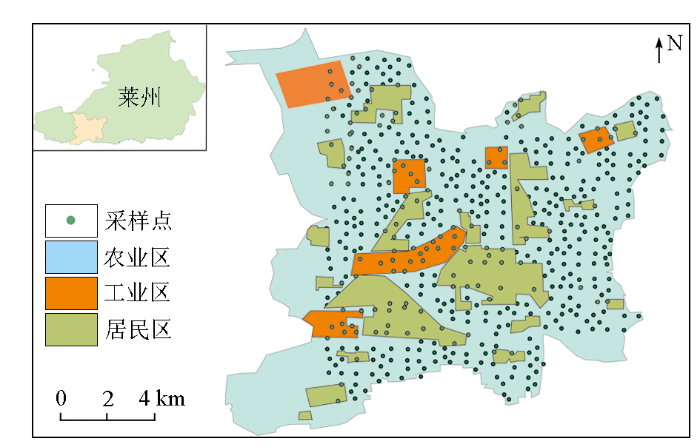
为开展本次研究,于2022年8~10月采用网格布点法系统性采集土壤样品,共布设采样点499个(图1)。采用土钻法采取0~20 cm土层样品,在每个样点共取5个子样进行混合,剔除杂物,采用四分法留取1 000 g封存登记。
图1
2.2 分析测试
采集的样品在实验室自然风干,进一步剔除杂质后研磨,过0.074 mm孔径筛后登记存放,以备进行土壤样品重金属全量测定。土壤样品测定工作由中国地质调查局烟台海岸带地质调查中心分析测试实验室完成,测定指标、方法及仪器见表1。测定过程采用GSS系列标准土壤样品、空白试验与平行样品试验进行全程质量控制。Hg、Cd、As、Pb、Cu、Cr、Zn和Ni检出限分别为0.005×10⁻⁶、0.021×10⁻⁶、0.2×10⁻⁶、0.5×10⁻⁶、0.5×10⁻⁶、5×10⁻⁶、4×10⁻⁶和0.2×10⁻⁶,样品加标回收率为94.3%~105.9%,平行样品分析偏差小于±5%。各指标的检出限、加标回收率和精准度均符合有关规范要求,测定结果准确可靠。
表1 土壤重金属含量测定方法及仪器
Table 1
| 指标 | 方法来源 | 测定仪器 |
|---|---|---|
| As | 《岩石矿物分析》氢化物发生—原子荧光光谱法测定砷、锑、铋(DZG20.01—2011) | 原子荧光光度计(AFS-8330) |
| Cu、Ni、 Zn | 《岩石矿物分析》电感耦合等离子体发射法测定27种主、次、痕量元素(DZG20.01—2011) | 等离子光谱仪(iCAP 6300) |
| Cr、Cd、 Pb | 《岩石矿物分析》电感耦合等离子体质谱法测定30种痕量元素(DZG20.01—2011) | 等离子体质谱(iCAP Q) |
| Hg | 《岩石矿物分析》冷蒸汽—原子荧光光谱法测定汞(DZG20.01—2011) | 原子荧光仪(XGY1011A) |
2.3 土壤重金属污染评价方法
2.3.1 单因子污染指数法
单因子污染指数法常用于对土壤重金属污染程度进行评价,常以土壤元素的背景值作为评价标准[37],公式如下:
式中:Pi为单因子污染指数;Ci为第i种重金属元素的实测值;Bi为庞绪贵等[38]总结的第i种元素的山东省烟台市土壤地球化学背景值。
2.3.2 内梅罗污染指数法
内梅罗污染指数法可以综合反映点位所有重金属综合污染程度,并突出最大污染值的影响[29],公式如下:
式中:PN为内梅罗污染指数;Pmax、Pave分别为某一重金属元素单因子污染指数Pi的最大值和平均值。
2.3.3 地累积指数法
地累积指数法广泛用于土壤重金属污染评价[25],公式如下:
2.3.4 潜在生态风险指数法
潜在生态风险指数法不仅考虑了重金属含量和多元素的协同作用,也考虑了重金属的毒性效应和生态效应的影响[33],公式为:
表2 重金属元素毒性响应系数
Table 2
| 元素 | Hg | Cd | As | Pb | Ni | Cu | Cr | Zn |
|---|---|---|---|---|---|---|---|---|
| 毒性响应系数( | 40 | 30 | 10 | 5 | 5 | 5 | 2 | 1 |
表3 土壤重金属评价标准
Table 3
| 单因子指数法 | 内梅罗指数法 | 地累积指数法 | 潜在生态风险指数法 | |||||
|---|---|---|---|---|---|---|---|---|
| Pi | 污染程度 | PN | 污染程度 | Igeo | 污染程度 | RI | 风险等级 | |
| Pi≤1 | 无污染 | PN≤0.7 | 清洁 | Igeo≤0 | 无 | RI<150 | 轻微危害 | |
| 1<Pi≤2 | 轻微污染 | 0.7<PN≤1 | 警戒 | 0<Igeo≤1 | 无—中度 | 40≤ | 150≤RI<300 | 中等危害 |
| 2<Pi≤3 | 轻度污染 | 1<PN≤2 | 轻度污染 | 1<Igeo≤2 | 中度 | 80≤ | 300≤RI<600 | 强危害 |
| 3<Pi≤5 | 中度污染 | 2<PN≤3 | 中度污染 | 2<Igeo≤3 | 中—强度 | 160≤ | 600≤RI<1200 | 很强危害 |
| Pi>5 | 重度污染 | PN>3 | 重度污染 | 3<Igeo≤4 | 强度 | RI≥1200 | 极强危害 | |
| 4<Igeo≤5 | 强度—极强 | |||||||
| Igeo>5 | 极强 | |||||||
2.4 数据处理
采用SPSS 20软件对数据进行处理和统计分析,使用CorelDRAW 2019、Origin 2019和ArcGIS 10.8软件进行图件绘制。
3 结果及分析
3.1 土壤重金属元素含量描述性统计
对研究区表层土壤重金属含量特征进行统计(表4),土壤中Hg、Cu、Ni、Zn、As、Cr、Cd和Pb含量范围分别为(0.005~0.258)×10-6、(2.66~529.00)×10-6、(4.90~203.00)×10-6、(13.3~1 100.0)×10-6、(1.40~41.50)×10-6、(17.70~472.00)×10-6、(0.029~7.200)×10-6和(12.857~347.100)×10-6。其中Hg、Cd、As和Pb含量均值均超过烟台市土壤重金属背景值(以下简称背景值),分别为背景值的1.5、1.4、1.2和1.1倍,表明土壤中Hg、Cd、As和Pb已经出现富集趋势。Cu、Ni、Zn和Cr含量均值均低于背景值,分别为背景值的0.9、0.8、0.9和0.9倍。
表4 研究区土壤重金属元素含量统计特征
Table 4
| 重金属 | 均值/10-6 | 标准差 | 偏度 | 峰度 | 变异系数/% | 范围/10-6 | 背景值[38]/10-6 | 背景值变异系数/% |
|---|---|---|---|---|---|---|---|---|
| Hg | 0.051 | 30.9 | 2.8 | 13 | 60.3 | 0.005~0.258 | 34 | 47.0 |
| Cu | 22.19 | 29.6 | 13.1 | 200.2 | 133.5 | 2.66~529.00 | 26 | 52.0 |
| Ni | 20.44 | 10.9 | 11.3 | 171.7 | 33.3 | 4.90~203.00 | 24.6 | 39.0 |
| Zn | 54.6 | 50.5 | 18.2 | 371.7 | 92.5 | 13.3~1100.0 | 60.4 | 30.0 |
| As | 7.52 | 2.9 | 3.8 | 39.2 | 39.0 | 1.4~41.50 | 6.4 | 34.0 |
| Cr | 50.32 | 24.1 | 13.2 | 212.2 | 47.9 | 17.7~472.00 | 57 | 38.0 |
| Cd | 0.160 | 0.4 | 16.9 | 323.5 | 218.1 | 0.029~7.200 | 0.12 | 35.0 |
| Pb | 30.070 | 18.8 | 12 | 181.6 | 62.5 | 12.857~347.100 | 27.2 | 23.0 |
变异系数(CV)常用来表征样本空间变异性大小和人为因素影响程度。一般认为,CV<20%为弱变异;20%≤CV<50%为中等变异;50%≤CV<100%为强变异;CV≥100%为异常强变异[40]。研究区土壤重金属含量变异程度从大到小依次为Cd>Cu>Zn>Pb>Hg>Cr>As>Ni,变异系数分别为218.1%、133.5%、92.5%、62.5%、60.3%、47.9%、39.0%和33.3%,各重金属元素变异系数除Ni外均大于烟台市重金属背景值变异系数,其中Cd、Cu、Zn、Pb和Hg为强变异,Cr、As和Ni为中等变异。前人研究表明,土壤重金属空间分布特征受控于自然条件和人为活动,其变异系数与人类活动干扰程度成正比[41],研究区土壤重金属含量在空间分布具有中等—显著差异性,显示人类活动在一定程度上影响了土壤重金属分布。
3.2 土壤重金属元素空间分布特征
土壤重金属元素空间分布特征可以反映区域土壤重金属的空间维度特性,空间插值分析是研究土壤重金属空间分布特征常用的方法[42]。普通克里金法广泛用于土壤重金属的空间分布研究,其原理是通过对已测得的土壤重金属含量进行空间插值,来预测未知点的土壤重金属浓度[43]。从研究区土壤重金属空间分布(图2)可以看出,Hg、As、Cd和Pb在土壤中出现了一定程度的富集,Hg、As、Cd和Pb大部分样点含量高于元素背景值。Hg含量在研究区整体较高,呈由西南向东北逐渐降低的趋势,低值区仅在西北、东北及东南部呈斑状分布。As含量呈西高东低的分布趋势,高值区主要呈片状、斑状、条带状分布于整个研究区。Cd含量整体呈西部高于东部的分布趋势,高值区呈斑状分布。Pb含量呈南高北低、西高东低的分布趋势,西南地区Pb含量远高于背景值,高值区主要呈斑状、条带状分布于西南部地区,东北地区高值区呈斑状零星分布。Cu、Ni、Zn和Cr在土壤中含量整体较低,大部分样点含量低于背景值,高值区呈斑状零星分布,污染程度较为缓和。在研究区西北部出现一处Cu、Cr、Zn、Pb和Cd的高值、极高值重合区域,经实地考察该区域分布着大量机械制造和铸铁冶炼工厂,工业活动影响着该区域重金属分布特征。整体上,不同功能区土壤重金属含量具有较大的差异,含量分布特征表现为工业区>居民区>农业区的趋势。
图2
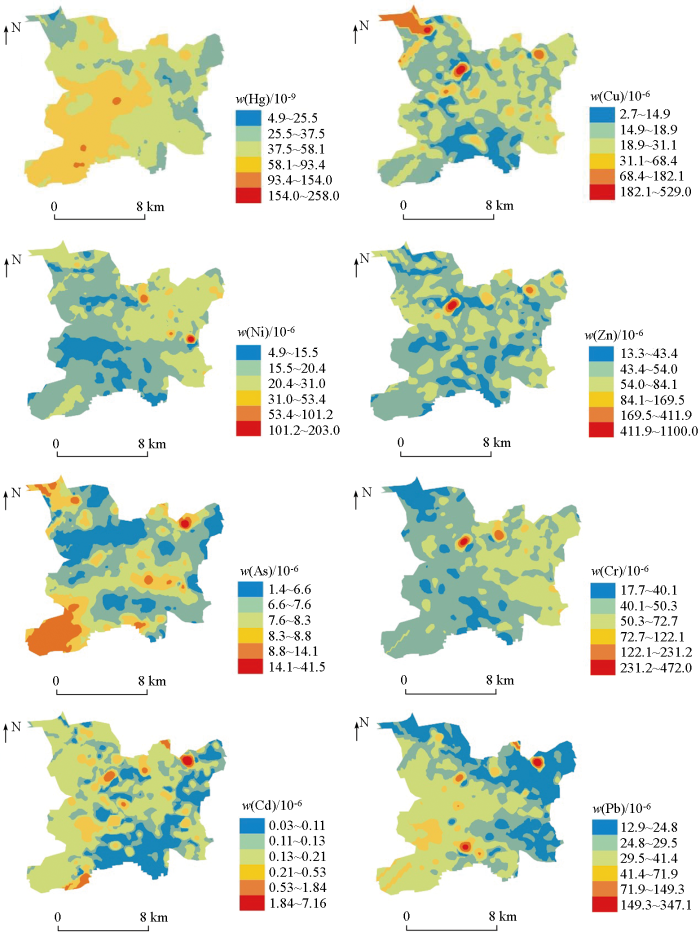
图2
研究区土壤重金属元素含量空间分布
Fig.2
The spatial distribution of heavy metal elements in soils in the study area
3.3 土壤重金属元素相关性和主成分分析
表5 土壤重金属元素Pearson相关性分析
Table 5
| 元素 | Hg | Cu | Ni | Zn | As | Cr | Cd | Pb |
|---|---|---|---|---|---|---|---|---|
| Hg | 1 | |||||||
| Cu | 0.067 | 1 | ||||||
| Ni | -0.012 | 0.152** | 1 | |||||
| Zn | 0.102* | 0.844** | 0.176** | 1 | ||||
| As | 0.312** | 0.309** | 0.053 | 0.137** | 1 | |||
| Cr | -0.004 | 0.661** | 0.361** | 0.848** | -0.030 | 1 | ||
| Cd | 0.308** | 0.513** | 0.058 | 0.505** | 0.490** | 0.284** | 1 | |
| Pb | 0.377** | 0.399** | 0.023 | 0.430** | 0.421** | 0.215** | 0.793** | 1 |
注:“*”表示在 0.05 水平(双侧)上显著相关,“**”表示在0.01 水平(双侧)上显著相关。
表6 土壤重金属元素主成分分析
Table 6
| 元素 | 主成分 | ||
|---|---|---|---|
| 1 | 2 | 3 | |
| Hg | 0.323 | 0.564 | 0.243 |
| Cu | 0.841 | -0.27 | -0.18 |
| Ni | 0.247 | -0.373 | 0.872 |
| Zn | 0.865 | -0.39 | -0.188 |
| As | 0.468 | 0.567 | 0.215 |
| Cr | 0.7 | -0.616 | 0.012 |
| Cd | 0.797 | 0.384 | -0.062 |
| Pb | 0.727 | 0.459 | -0.055 |
| 特征值 | 3.494 | 1.74 | 1.04 |
| 贡献率/% | 43.130 | 21.479 | 12.838 |
| 累积贡献率/% | 43.13 | 64.609 | 77.447 |
图3
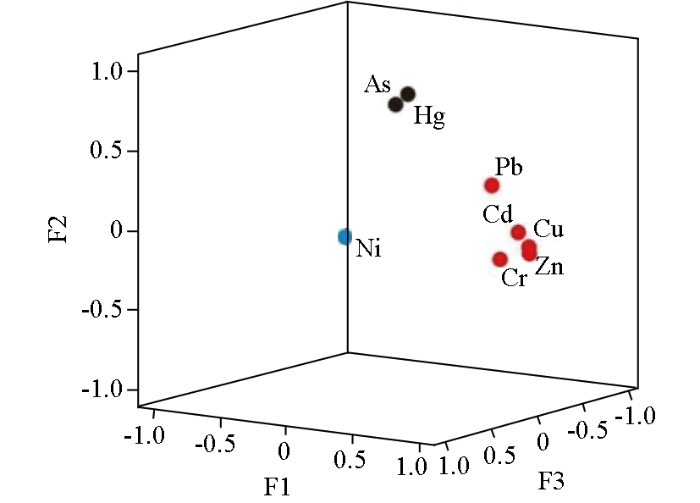
同一主成分下具有较高因子载荷的重金属可能具有相同的来源[29]。主成分1中主要重金属元素为Cd、Pb、Cu、Zn和Cr。相关性分析中也显示Cd、Pb、Cu、Zn和Cr之间均呈明显—显著的正相关性,表明可能具有相同的物源。研究区内分布着大量的金属冶炼工厂、塑料、化工、机械、电镀、纺织企业,工业区内道路密集交通发达。工业活动排放的“三废”中常含有大量Cu、Cr、Zn、Pb和Cd等重金属,可通过排放进入土壤和水体[45-46];金属冶炼厂周边土壤重金属Pb、Cd、Zn、Cr和Cu含量常显著高于土壤背景值[47-48];重金属Pb、Zn常通过汽车尾气排放和零部件磨损呈高值分布在道路周边土壤[4]。研究区土壤中Cd、Pb、Cu、Zn和Cr重金属高值区与工业区位置具有一致性,表明土壤中Pb、Cd、Zn、Cr和Cu主要来源于工业活动和交通运输活动。
主成分3中主要重金属元素为Ni,Ni在研究区土壤中含量平均值低于背景值,几乎不存在富集现象,空间分布较为均匀,高值区仅在个别区域呈斑状分布,推测Ni受人为活动影响较小,Ni主要来源于土壤母质。
3.4 土壤重金属污染程度
3.4.1 土壤重金属单因子污染风险评价
土壤重金属单因子污染指数Pi(表7)显示,土壤重金属Pi均值从大到小依次为Hg>Cd>As>Pb>Zn>Cr>Cu=Ni,分别为1.51、1.34、1.18、1.11、0.90、0.88、0.85和0.85,Hg、Cd、As和Pb整体为轻微污染,Zn、Cr、Cu和Ni整体为无污染状态。8种重金属元素均存在轻度以上污染,说明重金属元素在土壤中均存在不同程度累积,其中Hg和Cd轻度污染及以上比例分别为18.4%和6.0%,说明Hg和Cd为研究区污染水平较高的元素。
表7 土壤重金属元素单因子污染评价
Table 7
| 元素 | 污染指数范围 | 污染指数均值 | 不同污染级别样点占比/% | ||||
|---|---|---|---|---|---|---|---|
| 无污染 | 轻微污染 | 轻度污染 | 中度污染 | 重度污染 | |||
| Hg | 0.14~7.59 | 1.51 | 26.1 | 55.5 | 13.0 | 3.6 | 1.8 |
| Cu | 0.10~20.35 | 0.85 | 87.4 | 10.2 | 1.4 | 0.4 | 0.6 |
| Ni | 0.20~8.46 | 0.85 | 83.4 | 15.8 | 0.4 | 0 | 0.4 |
| Zn | 0.22~18.21 | 0.90 | 81.6 | 17.6 | 0 | 0.4 | 0.4 |
| As | 0.22~6.48 | 1.18 | 30.1 | 67.5 | 2.0 | 0 | 0.4 |
| Cr | 0.31~8.23 | 0.88 | 86.8 | 12.6 | 0.2 | 0 | 0.4 |
| Cd | 0.24~59.57 | 1.34 | 46.5 | 47.5 | 3.6 | 0.8 | 1.6 |
| Pb | 0.47~12.76 | 1.11 | 42.5 | 55.5 | 1.4 | 0 | 0.6 |
3.4.2 土壤重金属内梅罗综合污染指数法
内梅罗综合污染指数结果(表8)显示,研究区土壤内梅罗综合污染指数范围为0.71~43.14,均值为1.64,所有样品综合污染指数均超过了警戒值。轻度污染占比最大为72.7%,说明研究区土壤重金属污染整体呈轻度污染。内梅罗综合污染指数计算强调最大值的特点,元素Hg和Cd是影响内梅罗综合污染指数的主要原因。
表8 内梅罗综合污染指数评价
Table 8
| 内梅罗指 数范围 | 内梅罗指 数均值 | 不同污染指数分级样点占比/% | ||||
|---|---|---|---|---|---|---|
| 清洁 | 警戒 | 轻度污染 | 中度污染 | 重度污染 | ||
| 0.71~43.14 | 1.64 | 0 | 13.6 | 72.7 | 9.8 | 3.8 |
3.4.3 地累积指数法评价结果
地累积指数法结果(表9)显示,研究区土壤Hg污染程度最高,无污染样品仅占26.1%,18.4%的样品中Hg达到中度及以上污染。As和Cd污染程度次之,13.4%样品中的As和12.0%样品中的Cd存在污染,其中个别样品中Cd达到强度和极强度污染。Cu、Ni、Zn、Cr和Pb污染程度最低,大部分样品为无污染,仅在个别点位存在污染,其中Cu、Zn和Pb均各有一个点位达到强度污染水平。总的来说,研究区土壤重金属产生了一定程度的污染,特别是Hg,其次为As和Cd,应当引起重视。
表9 地累积指数法污染评价
Table 9
| 元素 | 地累积指数 范围 | 地累积指数 均值 | 不同污染指数分级样点占比/% | ||||||
|---|---|---|---|---|---|---|---|---|---|
| 无污染 | 无—中度污染 | 中度污染 | 中度—强污染 | 强度污染 | 强—极强污染 | 极强污染 | |||
| Hg | -2.79~2.92 | 0.38 | 26.1 | 55.5 | 16.6 | 1.8 | 0 | 0 | 0 |
| Cu | -3.87~3.76 | -1.02 | 95.6 | 3.4 | 0.4 | 0.2 | 0.4 | 0 | 0 |
| Ni | -2.88~2.50 | -0.90 | 98.4 | 1.2 | 0.2 | 0.2 | 0 | 0 | 0 |
| Zn | -2.77~3.60 | -0.83 | 98.6 | 0.6 | 0.6 | 0 | 0.2 | 0 | 0 |
| As | -2.78~2.11 | -0.45 | 86.6 | 13.0 | 0.2 | 0.2 | 0 | 0 | 0 |
| Cr | -2.27~2.46 | -0.82 | 99.0 | 0.6 | 0.2 | 0.2 | 0 | 0 | 0 |
| Cd | -2.63~5.31 | -0.49 | 88.0 | 9.6 | 1.2 | 0.6 | 0.4 | 0 | 0.2 |
| Pb | -1.67~3.09 | -0.53 | 94.4 | 5.0 | 0.2 | 0.2 | 0.2 | 0 | 0 |
3.5 土壤重金属风险评价
单项重金属元素的潜在生态风险分析结果(表10)显示,研究区Hg生态风险指数普遍较高,73.9%的样点属于中等及以上生态危害风险。Cd生态危害风险指数次之,18.4%的样点属于中等及以上生态危害风险,其中有0.6%的样点生态危害风险等级达到极强危害水平。Zn、Cr、Ni、Pb、As和Cu重金属元素的生态危害风险指数普遍较低,超过99%的样点为轻微危害风险等级,个别样点为中等、强危害等级。
表10 单项重金属元素潜在生态风险程度评价
Table 10
| 元素 | 均 值 | 不同污染指数分级样点占比/% | |||||
|---|---|---|---|---|---|---|---|
| 轻微 危害 | 中等 危害 | 强危害 | 很强 危害 | 极强 危害 | |||
| Hg | 5.8~303.5 | 60.2 | 26.1 | 55.5 | 16.6 | 1.8 | 0 |
| Cu | 0.5~101.7 | 4.3 | 99.4 | 0.4 | 0.2 | 0 | 0 |
| Ni | 1.0~42.3 | 4.3 | 99.8 | 0.2 | 0 | 0 | 0 |
| Zn | 0.2~18.2 | 0.9 | 100.0 | 0 | 0 | 0 | 0 |
| As | 2.2~64.8 | 11.8 | 99.6 | 0.4 | 0 | 0 | 0 |
| Cr | 0.6~16.6 | 1.8 | 100.0 | 0 | 0 | 0 | 0 |
| Cd | 7.3~1790.1 | 40.2 | 81.6 | 14.8 | 2.4 | 0.6 | 0.6 |
| Pb | 2.4~63.8 | 5.5 | 99.8 | 0.2 | 0 | 0 | 0 |
重金属元素综合潜在生态风险分析结果见表11,从风险程度来看,轻微风险等级样品占比最多,占比为84.0%,其次为中等风险等级样品,占比14.4%,轻微—中等风险等级样品占比为98.4%。强和很强风险等级样品占比分别为1.4%和0.2%,强和很强风险等级样品均分布工业区周边,与工业区分布具有较好的一致性。总的来说,研究区重金属元素的综合潜在生态风险整体较低,工业活动产生的“三废”对局部土壤造成了重金属的富集。
表11 多种重金属元素潜在生态风险程度评价
Table 11
| 综合潜在生态 风险指数范围 | 均值 | 不同污染指数分级样点占比/% | ||||
|---|---|---|---|---|---|---|
| 轻微 危害 | 中等 危害 | 强危害 | 很强 危害 | 极强 危害 | ||
| 37.8~864.7 | 121.4 | 0 | 0.14 | 0.73 | 0.10 | 0.04 |
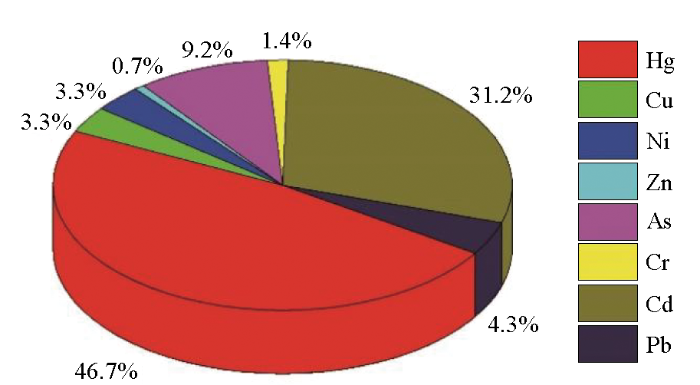
为直观了解单一污染因子对土壤综合潜在生态风险影响程度,将单一污染因子值除以综合值,计算出单一污染因子指数贡献率(图4)。结果显示,各重金属污染因子指数贡献率差异显著,相差可达数十倍。其中Hg为土壤重金属污染最大污染因素,污染指数贡献率为47.94%,其次为Cd,污染指数贡献率为29.45%,As污染指数贡献率为9.3%。Pb、Ni、Cu、Cr和Zn污染指数贡献率较低。Hg和Cd主要来源于工业活动,Hg和Cd在研究区最为富集,且毒性响应系数较高,使得Hg和Cd成为研究区土壤生态潜在风险污染最严重的重金属。结合同类型地区研究结果,重庆和上海某典型工业园土壤污染评价同样显示Hg和Cd为工业区污染风险较高的重金属元素[12,51-52],因此在工业区周边应加强对Hg和Cd元素污染的持续监测。
图4
4 结论
1)研究区土壤中Hg、Cd、As、Pb、Cu、Ni、Zn和Cr元素含量均值分别为0.051×10⁻⁶、0.16×10⁻⁶、7.52×10⁻⁶、30.07×10⁻⁶、22.19×10⁻⁶、20.44×10⁻⁶、54.60×10⁻⁶和50.32 ×10⁻⁶。土壤Hg、Cd、As、Pb含量均值超过背景值,土壤重金属含量在空间分布具有中等—显著差异性,显示人类活动在一定程度上影响了土壤重金属分布。
2)基于PCA主成分分析显示,Cd、Pb、Cu、Zn和Cr主要源于工业和交通源,As和Hg主要来源于工业、农业和生活源,Ni主要来源于土壤母质。
3)单因子污染指数显示土壤中Hg、Cd、As和Pb整体为轻微污染,Zn、Cr、Cu和Ni整体为无污染;内梅罗综合污染指数法表明研究区整体呈轻度污染;地累积指数法显示Hg、As和Cd呈较低程度污染,Cu、Ni、Zn、Cr和Pb整体为无污染状态。3种评价方法均显示Hg和Cd为研究区污染水平较高的元素。
4)单项元素潜在生态风险分析显示Hg、Cd生态风险指数普遍较高,Zn、Cr、Ni、Pb、As和Cu生态风险指数整体较低。综合潜在生态风险评价显示研究区土壤重金属主要为轻微危害等级,其次为中等危害等级,强和很强危害等级点位主要分布在工业区周边,工业活动产生的“三废”造成了周边土壤重金属富集。
参考文献
上海市典型工业用地土壤和地下水重金属复合污染特征及生态风险评价
[J].
Compound pollution characteristics and ecological risk assessment of heavy metals in soil and groundwater of typical industrial lands in Shanghai
[J].
黄河上游典型工业园区周边土壤重金属污染评价及来源解析
[J/OL].
Evaluation and source analysis of soil heavy metal pollution around typical Industrial parks in upper reaches of Yellow River
[J/OL].
单县表层土壤重金属污染特征、健康风险及溯源解析
[J].
Characteristics,health risks,and source analysis of heavy metal pollution in surface soil in Shanxian County
[J].
兰州市某交通干道土壤重金属分布特征及其对绿化植物的影响
[J].
DOI:10.13287/j.1001-9332.202004.040
[本文引用: 2]

为研究交通运输造成的重金属污染特征及潜在生态风险,选取兰州市某交通干道,利用原子吸收分光光度计检测了金属元素的含量,并利用单因子指数法和潜在生态风险指数法评价了土壤污染程度和潜在生态风险,进而分析了土壤重金属污染对绿化植物叶绿素和Ca含量的影响。结果表明: 城市交通导致土壤重金属Cr、Mn、Zn、Cu和Ni的含量均显著增高,且Cr、Pb和Cu达到了中度污染,潜在生态风险排序为Cu>Pb>Cr>Ni>Zn>Mn;槐树、月季、紫叶李和冬青卫矛对交通源重金属Pb、Mn、Zn、Ni等表现出不同程度的积聚作用;落叶植物槐树、月季和紫叶李叶片中叶绿素含量表现为路侧采样点>对照点,而常绿植物冬青卫矛和侧柏的叶绿素含量为对照点>路侧采样点,所有绿化植物叶片中Ca含量表现为路侧采样点>对照点,高的叶绿素和Ca含量可能有利于绿化植物在土壤重金属污染环境中生存。交通运输导致研究区域土壤中重金属Cr、Mn、Zn、Cu和Ni等的积累;槐树、月季、紫叶李和冬青卫矛等对Pb、Mn、Zn和Ni具有不同程度的积聚作用,可推荐为相应重金属污染土壤绿化植物。
Distribution characteristics of heavy metals in soil and its influence on greening plants in a main road of Lanzhou City,Northwest China
[J].
Assessment of heavy metal pollution and health risks in the soil-plant-human system in the Yangtze River Delta,China
[J].
北京市房山区土壤重金属元素分布、富集特征及来源解析
[J].
Distributions, enrichment characteristics,and sources of heavy metals in soils in Fangshan District,Beijing
[J].
基于GIS的黄淮海平原典型潮土区土壤重金属积累研究
[J].
Gis-based research on soil heavy metal accumulation in a fluvo-aquic soil area typical of the Huang-Huai-Hai plain
[J].
土壤—水稻系统重金属空间异质性研究——以浙江省嵊州市为例
[J].
Heavy metal contamination in soil-rice system and its spatial variation in Shengzhou City
[J].
工业发达城市区域耕地土壤重金属时空变异与来源变化
[J].
Spatio-temporal variation and source changes of heavy metals in cultivated soils in industrial developed urban areas
[J].
基于时空克里格的土壤重金属时空建模与预测
[J].
Spatio-temporal modeling and prediction of soil heavy metal based on spatio-temporal Kriging
[J].
Source apportionment and health risk assessment of heavy metals in soil for a township in Jiangsu Province,China
[J].
重庆某工业园土壤重金属污染特征、风险及源解析
[J].
Pollution characteristics,risk assessment and sources analysis of soil heavy metals in an industrial park of Chongqing
[J].
皖南典型区耕地土壤重金属富集特征、来源识别及健康风险评估
[J].
Enrichment characteristics,source identification,and health risk assessment of soil heavy metals in typical cultivated land in the mountainous area of southern Anhui Province
[J].
典型矿冶城市土壤重金属累积驱动因子研究和概率风险评估
[J].
DOI:10.13745/j.esf.sf.2023.11.46
明确土壤重金属来源及其健康风险是有效开展土壤污染风险管控的重要环节。本研究以某典型矿冶城市作为研究案例,采用地累积指数法(I<sub>geo</sub>)评价8种重金属(As、Cd、Cr、Cu、Ni、Pb、Zn和Hg)的污染特征,结合相关分析和正定矩阵因子分解(PMF)模型分析土壤重金属的潜在来源,进一步应用冗余分析探索土壤重金属累积的环境驱动因子,借助健康风险评估模型量化土壤重金属的风险水平。I<sub>geo</sub>结果显示,Cd污染处于中度污染水平,Cu、Pb和Zn污染处于轻度污染水平。依据PMF模型确定研究区域土壤重金属存在4个可能的污染来源,结合相关分析和区域特征,判断污染来源包括铅锌矿采选和冶炼源(Cd和Pb)、自然源与铜矿采选和冶炼的混合源(Cr、Ni、Cu和Pb)、有色金属冶炼排放源(Hg)、金矿采选和冶炼源(As),其中自然源和铜矿采选、冶炼的混合源是最主要的来源(70.10%)。冗余分析进一步明确,阳离子交换量、含水率和企业距离是土壤重金属累积的关键驱动因子。从健康风险评估结果来看,研究区域土壤重金属对儿童存在不可接受的致癌风险(概率为15.21%),对成人的致癌风险以及对儿童和成人的非致癌风险处于可接受风险水平。值得注意的是,As是研究区域主要的致癌因子,致癌风险的95%分位值(1.75×10<sup>-4</sup>)超过可接受风险阈值1×10<sup>-4</sup>。上述研究结果可为研究区域土壤重金属的优先管控和污染防治提供数据支撑。
Heavy metal accumulation in soils of a typical mining community:Driving factors and probabilistic health risk assessment
[J].
燃煤电厂重金属排放与周边土壤中重金属污染特征及健康风险
[J].
Heavy metal emissions from coal-fired power plants and heavy metal pollution characteristics and health risks in surrounding soils
[J].
Research on health risk assessment of heavy metals in soil based on multi-factor source apportionment:A case study in Guangdong Province,China
[J].
黄河下游典型区域土壤重金属来源解析及空间分布
[J].
Source identification and spatial distribution of heavy metals in soils in typical areas around the lower Yellow River
[J].
基于UNMIX模型的夹皮沟金矿区土壤重金属源解析
[J].
Source apportionment of soil heavy metals in Jiapigou goldmine based on the UNMIX model
[J].
基于正定矩阵因子分析模型的城郊农田土壤重金属源解析
[J].
Source appointment of heavy metals in suburban farmland soils based on positive matrix factorization
[J].
矿区土壤重金属污染修复技术研究进展
[J].
Research progress on remediation technology for heavy metal-contaminated soil in mines
[J].
建设用地重金属污染修复技术筛选模型构建
[J].
Construction of screening model for remediation of heavy metal pollution in construction land
[J].
矿区土壤重金属污染及修复技术研究进展
[J].
Review on heavy metal pollution and remediation technology in the soil of mining areas
[J].
工业发达城市土壤重金属时空变异与源解析
[J].
Spatiotemporal variability and source apportionment of soil heavy metals in a industrially developed city
[J].
西北某重工业区降尘重金属污染特征及源解析
[J].
Pollution characteristics and source analysis of heavy metals in the atmosphere dustfall of a typical heavy industrial city in northwest China
[J].
基于PMF-PCA/APCS与PERI的菏泽油用牡丹种植区表层土壤重金属潜在来源识别及生态风险评估
[J].
Potential source identification and ecological risk assessment of heavy metals in surface soil of Heze oil peony planting area based on PMF-PCA/APCS and PERI
[J].
聊城市典型农业区土壤重金属分布特征、生态风险及来源解析
[J].
Distribution, ecological risks,and sources of heavy metals in soil of typical agricultural areas in Liaocheng City
[J].
山东淄博玉米产区土壤砷含量空间变异研究
[J].
Spatial variability analysis of soil arsenic in Zibo maize producing area,Shandong Province
[J].
山东省典型污灌区土壤—小麦重金属健康风险评估
[J].
Health risk assessment of heavy metals in soil and wheat grain in the typical sewage irrigated area of Shandong Province
[J].
快速城市化区域不同用地类型土壤重金属含量分布特征及生态风险
[J].
Content and ecological risks of heavy metals in soil with different land uses in a rapidly urbanizing area
[J].
泰安市城区土壤重金属污染特征及风险评价
[J].
Pollution characteristics and risk assessment of Heavy metals in soil in urban area of Tai'an
[J].
山东淄博城市和近郊土壤元素地球化学特征及生态风险研究
[J].
A study of geochemical characteristics and ecological risk of elements in soil of urban and suburban areas of Zibo City,Shandong Province
[J].
黄河口国家公园湿地土壤重金属污染评价
[J].
Evaluation of soil pollution caused by heavy mental in wetland of the Yellow River Estuary National Park
[J].
胶东半岛某金矿周边土壤重金属的污染特征、来源分析及风险评价
[J].
Pollution characteristics,source analysis and risk assessment of heavy metals in soil around a gold mine in Jiaodong Peninsula
[J].
莱州湾沿岸海水入侵区地下水化学特征
[J].
Chemical characteristics of groundwater in coastal seawater intrusion area of Laizhou Bay
[J].
山东半岛北部泥质海岸带地下水水化学演化
[J].
Hydrochemical evolution of groundwater in muddy coastal zone of the northern Shandong Peninsula
[J].
城市工业区土壤重金属累积特征与来源解析——以上海市闵行区典型工业区为例
[J].
Accumulation and source apportionment of heavy metals in urban-industrial soils—A case study in Minhang District of Shanghai
[J].
山东省17市土壤地球化学背景值
[J].
Soil geochemical background value of 17 cities in Shandong Province
[J].
潜在生态危害指数法评价中重金属毒性系数计算
[J].
Calculation of heavy metals' toxicity coefficient in the evaluation of potential ecological risk index
[J].
基于PCA-APCS-MLR模型的西藏扎西岗湿地土壤重金属风险评价及来源解析
[J].
Soil heavy metal risk evaluation and source analysis of Zhaxigang wetland in Tibet based on PCA-APCS-MLR Model
[J].
DOI:10.13292/j.1000-4890.202406.038
[本文引用: 1]
Zhaxigang wetland is a typical plateau meadow swamp and an important ecological function reserve in Lhasa. Wetlands in Tibet are extremely fragile due to climate and topography, which should be given full consideration. To accurately assess the pollution status and sources of heavy metals in the soil of Zhaxigang wetland, we analyzed the contents of seven heavy metal elements (Cr, Ni, Zn, Pb, Cd, As and Hg) in 18 surface soil samples of Zhaxigang wetland. The pollution risks of heavy metals were evaluated by using the method of geo-accumulation index (<em>I</em><sub>geo</sub>) and pollution loading index (PLI). Based on PCA, the APCS-MLR model was used to analyze the pollution sources of heavy metals. The results showed that: (1) The contents of Cr and Ni in the surface soil of Zhaxigang wetland were lower than the background value of Tibetan soil. The contents of the other five elements were accumulated in different degrees. Except for Cd and As, the measured values of the other five elements were lower than the risk screening value in “Soil Environmental Quality Risk Control Standard for Soil Contamination of Agricultural Land of (GB 15618-2018)”. (2) Except for Cd and Hg, the <em>I</em><sub>geo</sub> values of other elements were less than 0, indicating a clean level. The overall PLI in the study area was 1.44, indicating light ecological hazard. Both evaluations showed that Cd and Hg were the main pollution elements in this area. More attention should be paid on those two elements, and routine monitoring should be strengthened. (3) The sources of heavy metals were mainly mixed industrial-transportation sources, natural sources, and mixed agricultural-coal combustion sources. Ni, Zn, Pb, Cd, and As were mainly from mixed industrial-transportation sources, Cr was mainly from natural sources, and the sources of Hg were mainly affected by human activities such as agriculture and coal combustion.<br><div> <br></div>
密云水库上游金矿区土壤重金属空间分布、来源及污染评价
[J].
Sources,spatial distribution and contamination assessments of heavy metals in gold mine area soils of Miyun Reservoir upstream,Beijing,China
[J].
中国西北地区银川市浅表土重金属污染特征及来源解析
[J/OL].
Characteristics and source identification of heavy metal pollution in shallow topsoil in Yinchuan City,northwest China
[J/OL].
宁夏石嘴山河滨工业园区表层土壤重金属污染的时空特征
[J].
Spatial and temporal characteristics of heavy metal concentration of surface soil in Hebin industrial park in Shizuishan northwest China
[J].
钢铁厂周边土壤重金属污染特征及风险评价——以闽西三明钢铁厂周边农田为例
[J].
DOI:10.11923/j.issn.2095-4050.cjas20191000246
[本文引用: 1]
为了明确闽西三明钢铁厂周边农田土壤重金属污染情况及其风险,于2019年5月在钢铁厂周边采集10个表层(0~20 cm)土壤样品,测定Pb、Cu、Zn、Cd、Hg和Ni的全量,利用单项污染指数法、内梅罗污染指数法和Hk?nson潜在生态危害指数法,评价重金属的污染水平和风险。结果表明,调查区域土壤重金属含量(除Hg超标率为80%外)均超过了福建省土壤背景值。相关性分析表明,土壤Pb、Cu、Zn、Cd、Ni具有同源性。评价结果表明,钢铁厂周边土壤重金属污染程度为Cd>Pb>Ni>Zn>Cu>Hg,调查区域所有土壤均达重度污染,处于很强和极强生态风险水平。因此,该钢铁厂周边农田土壤存在的重金属污染而产生的生态环境问题需引起高度重视,应优先开展Cd和Pb元素的防控,降低其生态风险。
Heavy metals in farmland surrounding the Sanming steel plant in western Fujian:Pollution characteristics and risk assessment
[J]
DOI:10.11923/j.issn.2095-4050.cjas20191000246
[本文引用: 1]
The paper aims to clarify the heavy metal pollution and risk in the farmland surrounding the Sanming Steel Plant in western Fujian. We collected 10 surface soil samples (0-20 cm) in May, 2019, determined the contents of Pb, Cu, Zn, Cd, Hg and Ni, and evaluated the levels and risks of heavy metals by the methods of the single pollution index, the Nemero pollution index, and Hk?nson potential ecological hazard index. The results showed that: the contents of heavy metals in the studied area exceeded the background value of soil environment in Fujian, except that Hg exceeded the standard rate by 80%; correlation analysis demonstrated that: Pb, Cu, Zn, Cd, Ni in soil were homologous; the evaluation results demonstrated that: the pollution degree of heavy metals in the soil surrounding the Sanming Steel Plant was: Cd>Pb>Ni>Zn>Cu>Hg; all the soils in the studied area were heavily polluted, reaching very strong and extremely strong ecological risk level. Therefore, more attention should be paid to the ecological environment problems caused by heavy metal pollution in the farmland surrounding the Sanming Steel Plant, the prevention and control of Cd and Pb in soil should be the priority to reduce their ecological risks.
上海宝山区农用土壤重金属分布与来源分析
[J].
Analysis on heavy metal concentrations in agricultural soils of Baoshan,Shanghai
[J]
长期定位施肥对土壤重金属含量的影响及环境评价
[J].
Effects of long-term fertilization on heavy-metal contents of soil and environmental quality evaluation
[J].
太原市土壤重金属污染及其潜在生态风险评价
[J].
Evaluation of heavy metal contamination and its potential ecological risk to the soil in Taiyuan,China
[J].
土壤汞的地球化学行为及其污染的防治对策
[J].
The geochemical behavior of mercury in soil and its pollution control
[J].


